


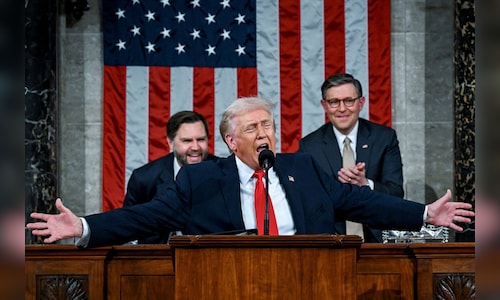
On February 20, the US Supreme Court Struck down Donald Trump’s sweeping tariff orders, declaring them illegitimate. Speaking about this ruling, Trump said, “And then just four days ago, an unfortunate ruling from the United States Supreme Court… Very unfortunate ruling.”
“But the good news is that almost all countries and corporations want to keep the deal that they already made,” he added.
Also read: SOTU 2026 Highlights: Trump pushes for voter ID, license ban for ‘illegal immigrants’
He said that the legal powers available to him as president to negotiate new trade arrangements “could be far worse for them,” arguing that tariffs would remain in place under “fully approved, untested alternative legal statutes.”
Separately, the US began collecting a temporary 10% global import tariff on Tuesday, February 24, after Trump signed an order replacing the broader duties struck down by the Supreme Court.
However, the White House said the president still intends to raise the rate to 15% under Section 122 of the Trade Act of 1974. While US Customs notified shippers that the levy would start at 10%, a White House official told Reuters that Trump has had “no change of heart” about increasing it to 15%, though no timeline was provided.
During his speech, Trump reiterated his long-standing claim that tariffs, paid by foreign countries, generate large sums of revenue for the United States.
“As time goes by, I believe that tariffs paid by foreign countries will, like in the past, substantially replace the modern-day system of income tax, taking a great financial burden off the people I love,” he said.
However, multiple studies suggest that the bulk of tariff costs has been borne by American citizens and businesses. A study published earlier this year by the New York Federal Reserve found that between January and August 2025, American consumers and businesses absorbed 94% of the impact of Trump’s tariffs, though that figure had eased to 86% by November.
According to Reuters, the US collected an estimated $175 billion last year from the tariffs that were invalidated by the Supreme Court’s ruling.
While Trump has described tariffs as “saving our country” and highlighted the revenue raised, the Associated Press reported that the proceeds remain modest relative to the federal government’s fiscal position.
Before the Supreme Court struck down the levies, the Congressional Budget Office estimated that the new tariffs would generate about $3 trillion over a decade, or roughly $300 billion per year.
Read more: US to stop collecting tariffs deemed illegal by Supreme Court on Feb. 24
That amount would not be sufficient to offset the projected cost of Trump’s $4.7 trillion in tax cuts, including provisions benefiting corporations and higher-income earners, nor would it be enough to meaningfully reduce last year’s $1.78 trillion annual budget deficit, AP reported.
Trump also argued that tariffs played a role in his foreign policy successes, saying they helped him secure international agreements and settle conflicts.
Despite the court setback, the president signalled he intends to continue using trade measures as a central pillar of his economic strategy.
Source link
#Trump #defends #tariffs #SOTU #calls #Supreme #Court #ruling #unfortunate #CNBC #TV18

