



“Those who do not learn history are doomed to repeat it.” So said George Santayana, the Spanish-American philosopher who was a star Harvard professor before resettling in Europe and becoming an influential public intellectual. Santayana’s writings served as a guiding light during some of the darkest days of two World Wars and the near cataclysm of the mid-20th century—a fate that none other than Ray Dalio sees repeating itself in the near future.
So maybe it’s time for a quick history lesson about the first couple industrial revolutions, with the labor force going through what leaders such as Nvidia’s Jensen Huang have described as another one: the AI boom.
In the early 1800s, as inventions like the spinning jenny and the steam engine reshaped Britain and soon the world, old mills were suddenly able to produce more goods than ever. Productivity soared in a way that historians are still grappling with measuring. Meanwhile, worker pay remained stagnant for more than 50 years—a phenomenon that economic historian Robert Allen called “Engels’s pause,” named after Friedrich Engels, the German industrialist and philosopher. Allen named this accordingly because that “pause” in worker wages led to, among other things, a widespread intellectual disillusionment with how capitalism was evolving. This aligned with ideas in the book that Engels was coauthoring with his associate Karl Marx. It was called The Communist Manifesto.
And this pause may be happening again, almost exactly 200 years later.
A history lesson
For decades, the economy expanded without delivering much improvement to the people actually operating the machines; industrialists grew fabulously wealthy while new factories stretched across the landscape, but workers still toiled for 14 hours a day in crowded conditions, unable to find a better job. The gains from technological progress accrued overwhelmingly to the owners of capital. Only later—once brand-new industries, like typing and manning phones, demanded more skilled labor, and political institutions shifted to meet that demand—did wages finally start to rise alongside productivity.
Now, economists are seeing echoes of that same pattern in the U.S. economy. Analysts at the Bank of America Institute have warned that recent productivity gains are accumulating on the profit side of the ledger, while wages and salaries gradually take up a smaller slice of GDP. “Profits are gaining ground vs. wages,” the economists wrote, explaining that “recent productivity gains have been piling as corporate profits, with labor income steadily falling as a share of U.S. GDP.”
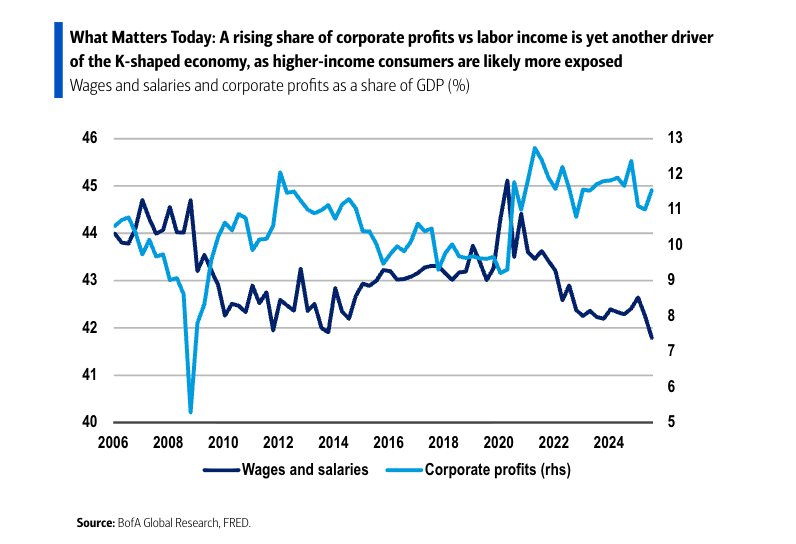
“It remains to be seen whether wages and salaries recoup some of their lost ground relative to corporate profits,” the researchers wrote.
This trend corresponds with what Albert Edwards—the cult analyst for Societe Generale, famed among finance nerds for his quotability and perma-bearish doomsday takes on markets—predicted in 2022 could be “the end of capitalism.” In November, he told Fortune that he stood by this take, particularly on corporate profits surging during the “greedflation” era, and warned that a “day of reckoning” was upon us at the middle of the decade.
That shift is happening at a moment when the headline economy looks mixed. The U.S. added only 181,000 jobs in 2025, according to revised Bureau of Labor Statistics data, a mere blip in the data that is a margin of error away from zero, far below the 1.46 million jobs added in 2024. Yet economic growth held up. Bank of America economists say they are tracking roughly 2% annualized GDP growth for the fourth quarter, a pace that suggests output is rising even as hiring cools.
Put those two trends together, and the math points in one direction: higher productivity per worker.
It’s unclear if the productivity gains are entirely from AI; BofA notes that the productivity surge started around the pandemic, years before ChatGPT was first released. Factors like remote work, increased digitalization, and slimmed down workforces may have contributed to the early surge in productivity. Many experts remain skeptical over AI’s revolutionizing impact in the workforce, three years on.
However, over the past few weeks, analysts have certainly shifted their tone, with warnings of an AI “takeoff” going viral, and markets selling off nearly $1 trillion in software stocks over fears that AI would replace engineers faster than anticipated. Over the weekend, leading Stanford researcher Erik Brynjolfsson argued in an essay that the U.S. is beginning to move out of the heavy investment phase of artificial intelligence and into a “harvest phase,” where years of spending start to translate into measurable productivity gains. His estimates suggest U.S. productivity growth roughly doubled in 2025 compared with the prior decade’s trend.
“The productivity revival is not just an indicator of the power of AI,” Brynjolfsson wrote. “It is a wake-up call to focus on the coming economic transformation.”
An economy of resentment and profit hoarding
Yet that economic transformation is not welcome by all—in fact, quite the opposite. What began as skepticism toward AI has curdled into a palpable AI hatred across the American workforce. Most Americans are terrified of AI, and few report being excited about the technology, even among self-described optimists. Workers resent being forced to use a technology that will then copy their ideas and processes, only to replace them in a few years’ time. A Gallup poll found that six in 10 Americans distrust AI, and most people agree that regulations prioritizing AI safety and security are crucial.
Meanwhile, corporate leaders—who are, as a whole, thrilled by the opportunities—have no idea how negative employee sentiment has become. A Harvard Business Review survey found that 76% of executives report their employees are feeling enthusiastic about AI adoption, when in reality, only 31% of individual contributors were excited about it.
The disconnect that BofA analysts found in their research might have something to do with it. Most workers have not yet felt the benefits of the AI boom in the stock market, but instead have grappled with a stalled labor market and higher prices from tariffs throughout the year. Meanwhile, higher-income consumers remain stable, insulated by stock gains and homeownership, while spending growth for everyone else is slowing.
“For now, higher profits relative to wages are yet another driver of a K-shaped economy,” BofA wrote.
Source link
#boss #loves #hate #Corporate #profits #capturing #extra #productivity #salary #isnt #Fortune

