




UK gym membership is becoming increasingly normalised among consumers, according to a new study from CIL Strategy Consultants and Total Fitness. With more than a third of people now identifying gym membership as essential spending, there is a growing opportunity for market saturation.
Around the world, the global health and fitness industry is expanding rapidly – as consumers look to continue their lockdown workout habits beyond the lockdown era. Health and wellness from home were high on the agenda during the height of the pandemic, with 30% of consumers intending to regularly work out at home even after lockdown measures eased.
Five years after lockdown measures eased, the legacy of that has seen a demonstrable leap in the penetration of gym membership among the UK public. In 2015, 14% of UK consumers were gym members, but according to a new study from CIL Strategy Consultants and Total Fitness, that had risen to 17% by the end of 2025.
Source: CIL Strategy Consultants, Total Fitness
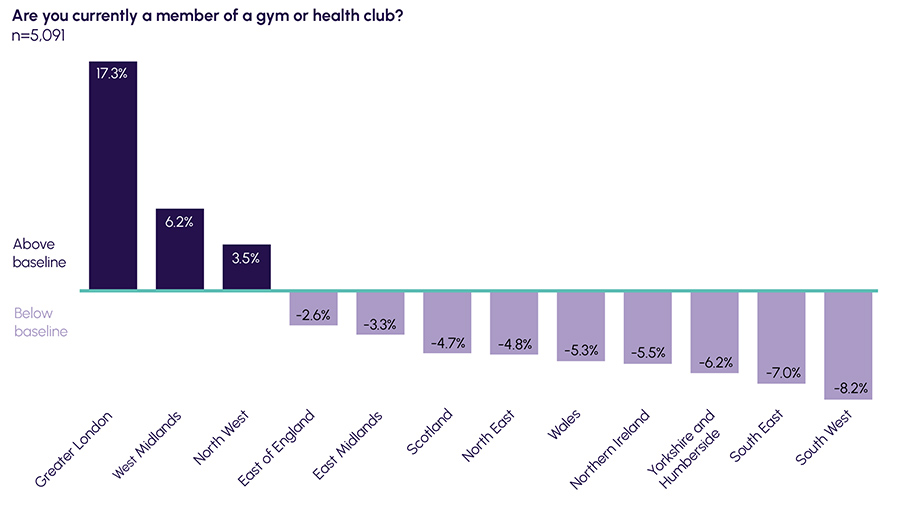
This is especially pronounced in the country’s most urban areas. The Greater London area – also one of the most affluent in the UK – leads the way with membership 17.3% above that baseline. Meanwhile, the West Midlands, which includes second city Birmingham, sits 6.2% above the baseline. And the North West, including the massive urban hubs of Manchester and Liverpool, is 3.5% ahead of the curve.
In lower-density areas, however, the trend is very different. The East of England is closest to the baseline – just 2.6% lower than the national average – but that ranges all the way down to the South West, where gym membership saturation is 8.2% lower. According to researchers, this suggests a market continuing to “normalise gym usage as a mainstream behaviour”, rather than simply obtaining “saturation”. And within this, there is likely targeted opportunity for “both private investment and public policy support, particularly into the private sector in lower-density and lower-income areas.”
Relating to public policy, another contributing factor to the rise of gym membership in the UK – and across the world’s largest economies – is a lack of support which the underfunded health system – or its expensive private counterpart – offers individuals. With an underlining implication that most governments simply advice people “don’t get sick, or it’ll cost you”, consumers are doing what they can to improve their odds of avoiding illness.
Source: CIL Strategy Consultants, Total Fitness
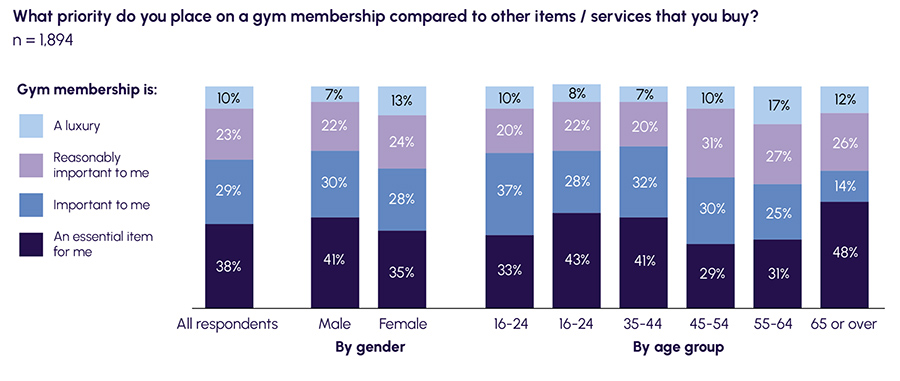
To that end, the researchers found that the way consumers view gym membership is rapidly shifting. Of all respondents, the largest portion of 38% said they saw it as an essential item. Meanwhile, just 10% said they saw gym membership as a discretionary item on their monthly bill now. This was most prevalent among men (only 7% of whom saw gym spending as a luxury, compared to 13% of women), and those aged 65 or over (48% of whom said it was an essential expense).
Emphasising the importance of the matter, at the same time, 36% of those who had gym memberships complemented visits there with another paid fitness service. Within that, 42% had another specialist gym membership, like crossfit, while 24% did an organised outdoor class or activity such as a sport.
CIL Partner Liam McGuinness commented, “Participation in fitness events is rising as part of a broader, structural shift rather than a short-term anomaly. As fitness continues to professionalise and take on the characteristics of a sport, an increasing share of gym-goers are focusing their training around clear, goal-driven outcomes. While this mindset is most evident among younger cohorts today, it is likely to spread steadily into older generations over time.”
Source link
#Consumers #longer #gym #membership #discretionary #spending

