




Entering into the fourth year of AI hype, experimentation, and adoption, a new study from Eden McCallum has consulted business leaders about their perceived impacts of the technology. The majority of executives to have sanctioned expensive generative AI transformations suggest a positive impact, but promised booms in productivity and profit still seem some way off – with just one-in-ten respondents noting changes to revenue resulting from their investments.
In late-2025, Eden McCallum surveyed 300 businesses in the UK, the US and the Netherlands for their views and experience of working with GenAI. According to the researchers, the responses point to “increased activity and experimentation, and also solid confidence that the new technology will generate greatly increased value in the years to come”.
Roughly a third of respondents said generative AI has already had “a significant or very significant impact on their business”. Of those, around 60% say that this impact has been positive. At the same time, the average number of ‘actions’ around the technology has almost doubled since the second quarter of 2023, as more and more firms weigh up their options.
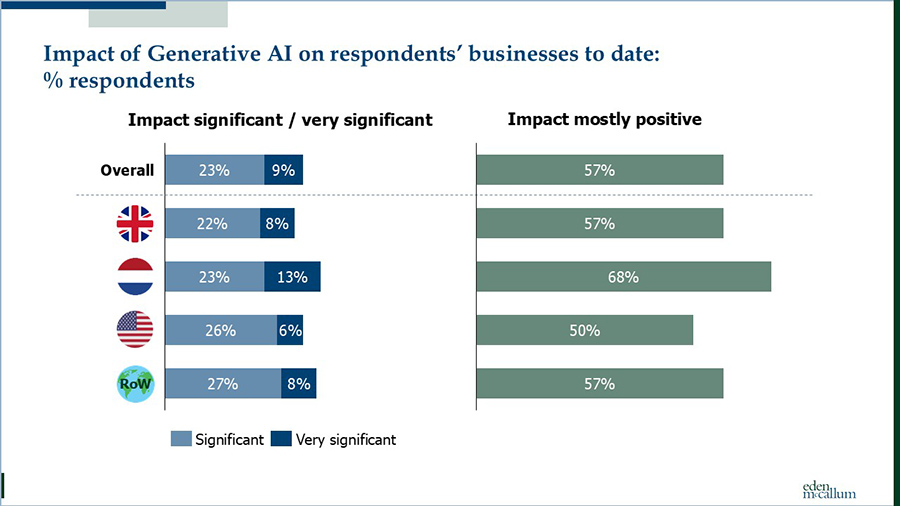
In 2023, 51% of respondents said they were exploring use cases, and that has now risen to 69% at the end of 2025. Meanwhile, the number actively experimenting with or planning use cases has grown from 49% to 67% over the same period. And more than half of firms are now using the technology to train staff – up from just 17% previously.
However, given the amount of time and money invested into AI tools at this point, that might not be the glowing recommendation it initially appears. To have passed three years since OpenAI opened ChatGPT up to the public, kicking off the excitement around business applications of the technology, and the largest applications of it are still exploratory, rather than scaled, company-wide solutions, or proprietary tools and analysis – rising from 14% to 28% – does not seem to be delivering on the speed and productivity the burgeoning AI market was sold on.
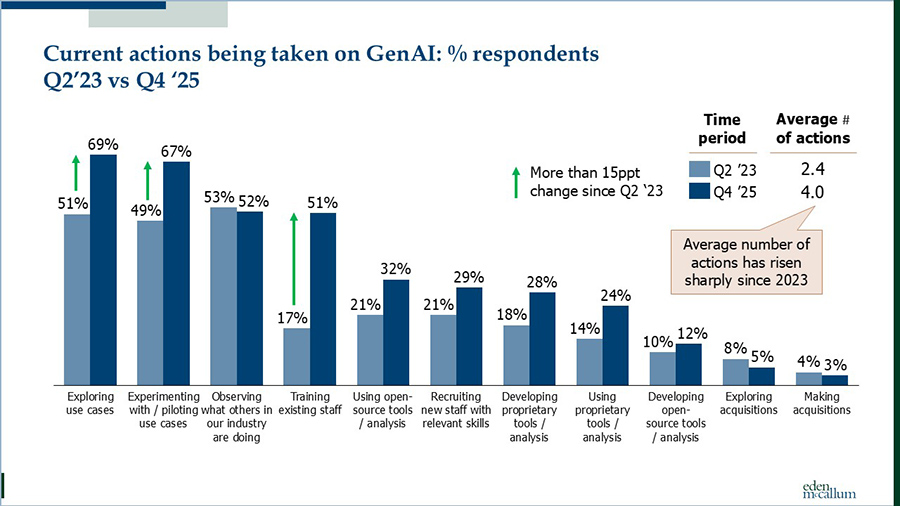
At the same time, failing to demonstrate a significant impact in two-thirds of the cases where it is deployed probably calls into question the ‘revolutionary’ billing of the technology. It is hard to imagine that during the original industrial revolution, only 57% of British factory owners would have said mechanised production was a ‘mostly positive’ replacement of complex and time-consuming manual labour, but the AI-age, which is so often likened to that historic era, sees exactly that – while in the world’s largest economy of the US, that figure falls to just 50%.
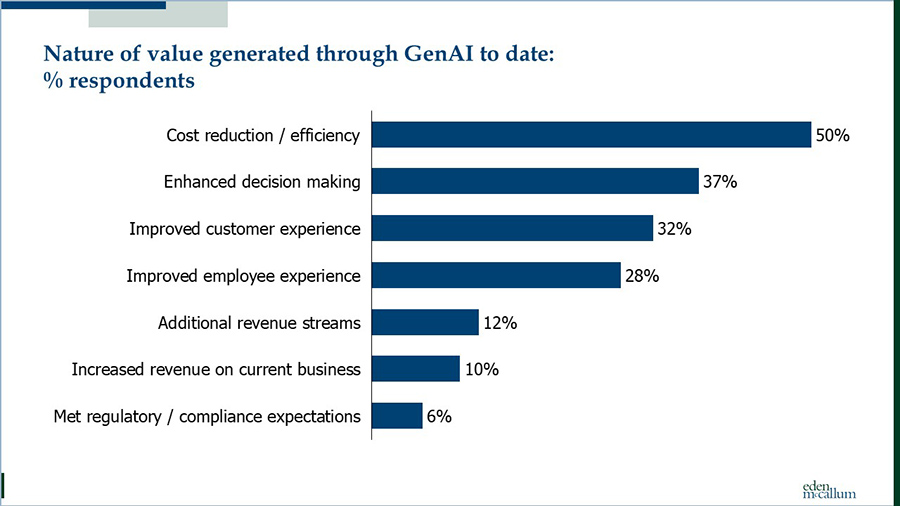
That is not to say that the benefits of AI are negligible to everyone involved. When it comes to identifying material benefits of AI, 50% of leaders point to cost-reduction and efficiency savings as the leading metric. Meanwhile, 37% suggest their decision-making has been enhanced, and 32% argue their customer experience has been improved. When it comes to securing their bottom-lines at the end of a difficult year, that might well prove very important – especially when executive bonuses are on the line. However, when it comes to expanding their business, to grow in the manner many firms need to, to appease their shareholders, just 10% said AI had increased revenue on their current business model. At the same time, despite the allegedly limitless innovative potential of the technology, only 12% said it had opened up additional revenue streams.
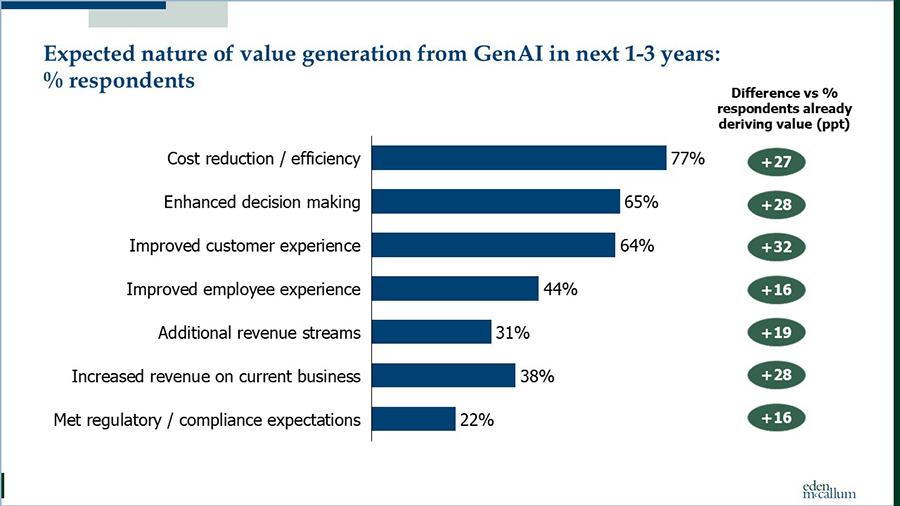
Still, leaders are undeterred. Looking ahead, they told Eden McCallum that they still expect the impact of generative AI to increase sharply. In the coming three years, 79% believe it will have significant impact – a stronger vote of confidence in AI’s future than was registered in a similar survey two years ago. And by then, a significant minority of 38% also expect to see increased revenue by then.
Dena McCallum, co-founder of Eden McCallum, noted, “While it has moved to the top of the agenda, and a great deal of activity is taking place, actual impact so far is somewhat limited. But the sense of potential is clear. There is no doubt this will be a game-changer on both efficiency and effectiveness across business functions and activities. It will be interesting to see where and how generative AI may level the playing field between small and large firms.”
What leaders assert about the effectiveness of their investments in AI might be best taken with a pinch of salt anyway. Besides their interest in arguing to shareholders that they aren’t simply shovelling money into a bottomless-pit, a string of recent reports have suggested that firms may be overestimating the levels of innovation they are achieving; and that they may not have the mechanisms in place to measure the actual returns on investment accurately. Indeed, only 15% of firms even bother to quantify the financial impact of data and AI in pounds or dollars – more than three years since the hype around AI kicked off an era of feverish investment in the technology.
That gravy-train may not be endless though, in the shadow of a now infamous MIT study found fewer than one-in-ten firms investing in AI had enjoyed a return on investment. To that end, at the turn of the year, PwC analysis further showed that 56% of CEOs now believe they have seen “no benefit” from funnelling funds into technology. So, as the economic picture darkens, and firms begin looking to cut costs, leaders might well need to provide more than positive sentiment, when calling for yet more funds to plug AI tools into their business.
Source link
#Excitement #remains #GenAI #revenue #impact #remains #minimal

