




For both buyers and sellers of companies, timing the deal is a key success criterion for its success. Rhiannon Ludlow, director at TH Global Capital, outlines why that timing should be centred around the business – and not the market.
Across global technology M&A cycles, boards and founders often fall back on the same line, they’ll consider a transaction once “the market improves.” It sounds sensible on the surface, but in practice it usually misses the point.
Recent data shows that this mindset blurs an important distinction – between waiting to time the market and choosing the right moment for the business itself. These are two very different decisions and confusing them can be costly.
Markets move in unpredictable ways. Economic conditions, interest rates, sector preferences and buyer sentiment all shift in response to forces well beyond any one company’s control. What is controllable, however, is a business’s own readiness – its operational strength, financial transparency and strategic positioning.
Market Volatility and M&A Activity
Global M&A activity has been uneven since the pandemic highs. After record levels in 2021, deal volumes and values fell sharply in 2022 as macroeconomic pressures built, pushing activity back toward more typical, pre-pandemic levels.
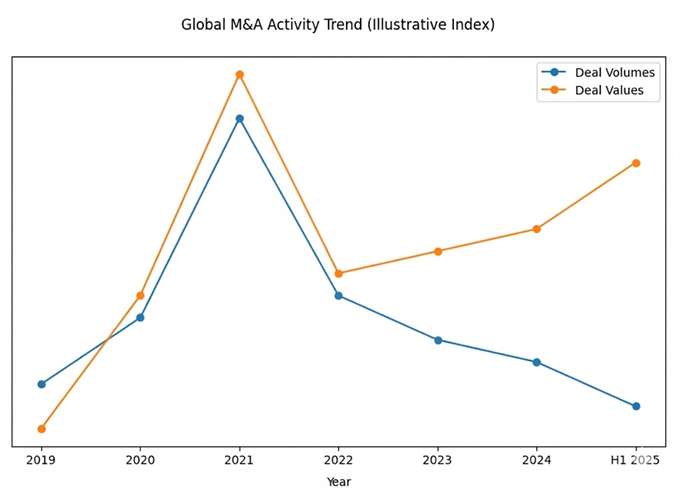
More recently, in the first half of 2025, global M&A volumes continued to fall even as deal values rose, signaling a market defined by fewer, larger transactions.
The takeaway is clear: buyers are still active, but far more selective. In this kind of environment, outcomes hinge less on trying to time the market and more on how well prepared the business truly is.
Prepared Businesses Capturing Opportunity
Accenture’s acquisition strategy offers a clear example of execution-driven M&A in technology services. In 2022 alone, the firm completed 23 acquisitions across digital, cloud, analytics, sustainability and related capabilities, reinforcing a long-standing, capability-led growth strategy rather than waiting for ideal market conditions.
This pattern points to a simple reality; strategic acquirers tend to focus on businesses that are operationally ready and strategically complementary, rather than waiting for perfect macro conditions.
Accenture’s approach reflects confidence in execution and long-term integration value, even when short-term valuations fluctuate.
A similar dynamic can be seen in technology and IT services with Capgemini’s 2025 acquisition of WNS for approximately $3.3 billion. By bringing WNS’s BPM and AI-led capabilities into the group, Capgemini doubled down on strengthening its market position and capability footprint, despite ongoing market uncertainty.
The Pitfalls of Market Timing
Businesses that put off engaging with buyers or advisors in the hope of improved sector metrics often find that buyer expectations have shifted by the time they return to market.
As broader dealmaking trends show, volumes may ease even as deal values hold up, signalling a buyer preference for high-quality assets in a more uncertain economic environment. This selectivity has two implications:
1) Valuation upside alone may not materialise simply because markets “improve”
2) Readiness in financial reporting, management depth and strategic clarity becomes a differentiator
The M&A Readiness Framework
Instead of treating a sale as a one-time event, top performers treat it as a permanent state of operational excellence.
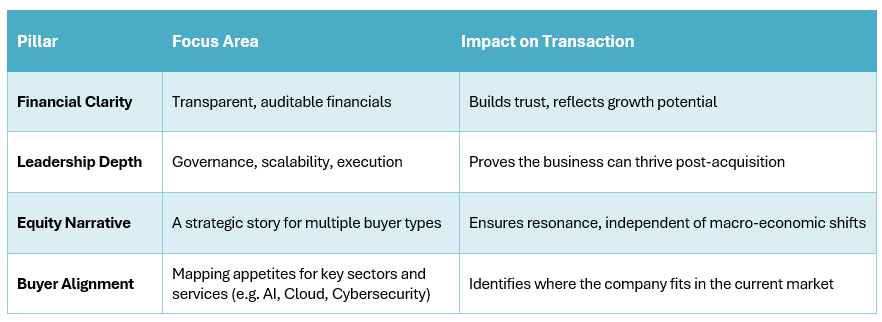
Preparation in these areas doesn’t compel a transaction; it creates optionality. When opportunities emerge, whether through unsolicited interest or a change in buyer demand, a well-prepared and credible business is positioned to move decisively.
The Key Takeaway
Timing the business strategically is a deliberate choice, as M&A cycles consistently show that attempting to time the market is inherently speculative. Furthermore, macroeconomic conditions will always evolve beyond the control of individual management teams. While broader market improvements can create more supportive deal environments, the most reliable driver of strong transactional outcomes is the underlying readiness of the business itself.
Leaders who focus on operational strength, financial transparency and clear strategic positioning create conditions for value capture regardless of market volatility. In doing so, they preserve optionality and retain agency over their transaction timelines, rather than allowing external market cycles to dictate outcomes.
At TH Global Capital, we work with founders and management teams well before a transaction is imminent – often through growth advisory and readiness planning rather than an immediate sale process. This early engagement strengthens fundamentals, preserves flexibility and ensures businesses are prepared to act decisively when market conditions or strategic opportunities change.
Source link
#distinction #matters #Timing #business #market

