


When students see poetry as a boring unit that’s all about nature, love, and feelings, it’s time to shake things up. Poets have always had a sense of humor, and students who appreciate sarcasm, wit, and outright jokes will love these funny poems. Put a few of these poems on the whiteboard or in their poetry packet and they’ll never look at poetry the same way again!
Jump to:
Our Favorite Funny Poems for Everyone
1. How Not To Have To Dry the Dishes by Shel Silverstein
“If you have to dry the dishes
(Such an awful, boring chore)”
Themes: Mischief, humor, chores
Literary devices: Punctuation, refrain
Shel Silverstein is the master of funny poems for kids. Use this poem as a mentor text when students write their own funny poems. Silverstein uses rhyme and punctuation to set the scene and set up the punchline at the end.
2. The Crocodile by Lewis Carroll
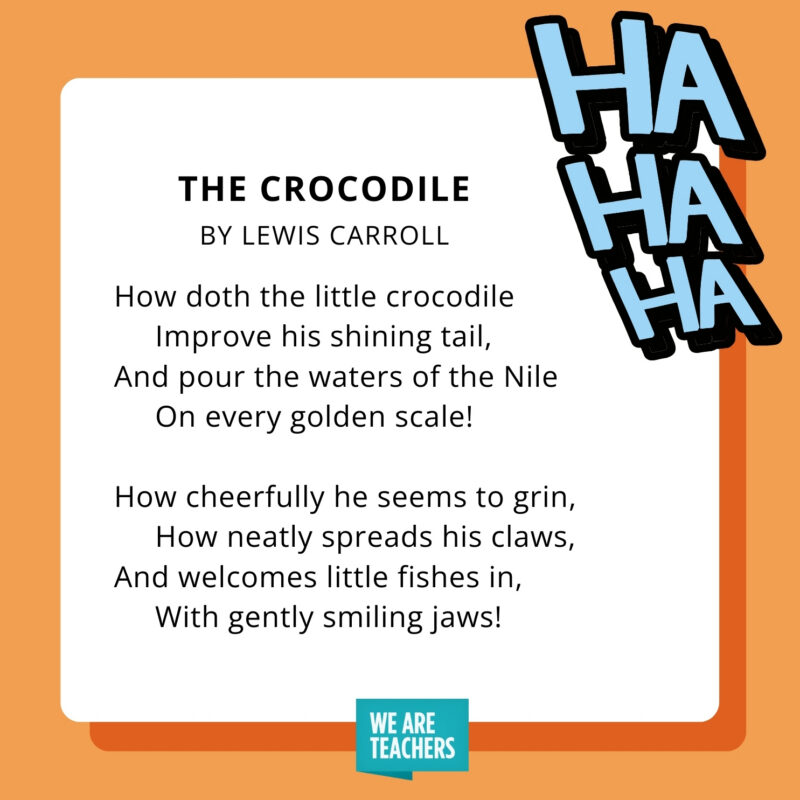
“How doth the little crocodile
Improve his shining tail …”
Themes: Deception, humor, animals
Literary devices: Rhyme, personification
This funny poem attributes human characteristics (“grin,” “welcomes little fishes in”) to a crocodile. Younger students can imagine the sneaky crocodile, while older students can discuss whether this poem was written for adults or children and why.
3. Be Glad Your Nose Is On Your Face by Jack Prelutsky
“Be glad your nose is on your face,
not pasted on some other place …”
Themes: Absurdity, contentment, humor, imagination
Literary devices: Contrast, rhyme, enjambment
A poem is a perfect place to imagine something ridiculous, like Prelutsky does in this poem. Students will giggle at all the ways Prelutsky expands on his premise that your nose could, in fact, have been placed somewhere else.
4. Don’t Go Into the Library by Alberto Rios
“The library is dangerous—
Don’t go in. If you do …”
Themes: Imagination, libraries, reading, irresistibility
Literary devices: Symbolism, enjambment, metaphor
This poem has a matter-of-fact style, so it’s a good one to show students who are learning how to analyze how authors insert their ideas into poems, and how they use poems to build to a final punch. This poem is also a great one to introduce students to the idea of enjambment, or when sentences continue across multiple lines, and extended metaphor—the library is not just a building but an entry point for imagination that is hard to resist.
5. Sick by Shel Silverstein
“‘I cannot go to school today,’”
Said little Peggy Ann McKay.”
Themes: Humor, motivation
Literary devices: Rhyme, hyperbole
Every elementary schooler should read this funny poem at least once. It’s a master class in drama that ends with a joke that lets all the air out of the balloon at once.
6. My Kitten Is a Ninja by Kenn Nesbitt
“My kitten is a ninja.
He wears a black disguise.”
Themes: Humor, pets
Literary devices: Rhyme, imagery, symbolism
Another silly scenario poem. Use this poem when you’re teaching students how to analyze structure and rhyme.
7. My Shadow by Robert Louis Stevenson
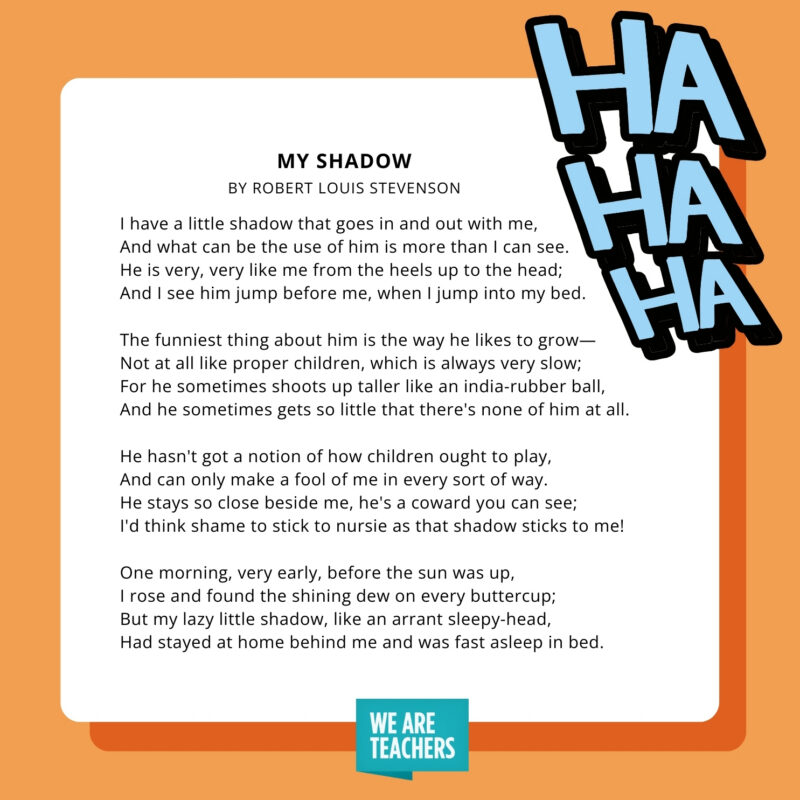
“I have a little shadow that goes in and out with me …”
Themes: Imagination, shadows
Literary devices: Rhyme, personification
You have to read the entire poem to see the humor in a shadow personified as busy until it’s time to get out of bed. This poem is also good to teach vocabulary, with words like “notion,” “proper,” and “coward.”
8. My Next Door Neighbor Is a Witch by Samiya Vallee
“My next door neighbor is a witch,
And she lives way down in a ditch.”
Themes: Humor, absurdity, the grotesque
Literary devices: Rhyme, imagery
The humor in this poem is in the details that the poet includes, like the “big fat wart” and “seventeen pimples on her toes.” Read it aloud and talk about the details that make this poem silly.
9. The Boy Who Didn’t Like Ice Cream by Rebecca Syx
“A boy who didn’t like ice cream?
That almost seems like a crime!”
Themes: Food, humor, trying new things
Literary devices: Rhyme, conversation, narrative
This poem is easy to read with a hysterical tone—a boy who doesn’t like ice cream! Students can practice reading it aloud to try to get the most humor out of each stanza.
10. Sweet Treat Dream by Gillian M. Ward
“If the world were made of chocolate
I know what I would do.”
Themes: Humor, food
Literary devices: Rhyme, repetition
Technically, this poem is a good example of how a poet uses a repeated word or phrase to drive their point home. It’s also a fun example of how to use poetry to imagine a silly scenario from every angle.
11. Don’t Be Silly by Dave Moran
“Are there bugs that live on the moon?
Can July come before June?”
Themes: Humor, questioning, absurdity
Literary devices: Rhyme, refrain
How often have students been told to be serious or stop being silly? This poem invites them to be even more silly. Read it and then imagine your own stanza. What silly scenes can you build into one stanza?
12. At the Zoo by William Makepeace Thackery
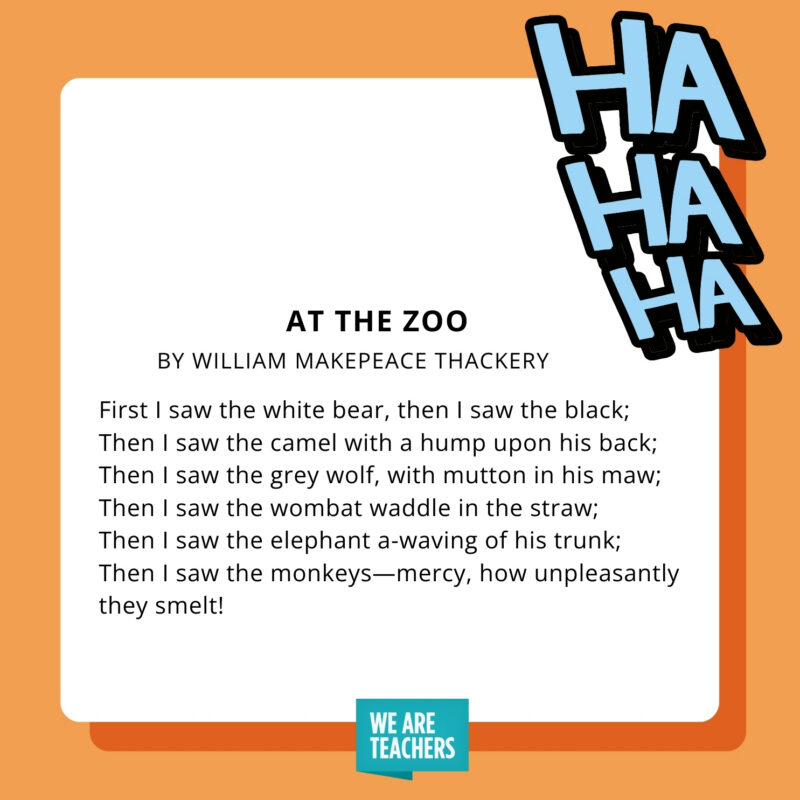
“First I saw the white bear, then I saw the black;
Then I saw the camel with a hump upon his back …”
Themes: Childhood, animals
Literary devices: Rhyme, repetition
This short poem is a great one to introduce students to poetry, or to get reluctant readers into poetry. Most students can relate to the experience of visiting a zoo, and students can analyze how the rhyming and repetition make the poem fun to read.
13. Bleezer’s Ice Cream by Jack Prelutsky
“I am Ebeneezer Bleezer
I run BLEEZER’S ICE CREAM STORE”
Themes: Humor, childhood, ice cream
Literary devices: Rhyme, capitalization, enjambment
This is another fun, classic poem that students can analyze for themes of childhood. Read it alongside other Jack Prelutsky and Shel Silverstein poems to get a feel for the themes in children’s poetry.
14. Tom Tigercat by J. Patrick Lewis
“Tom Tigercat is noted
for his manners and his wit.”
Themes: Playfulness, independence, animals
Literary devices: Personification, rhyme, wordplay, enjambment
When you get to the last line in this poem, it’s a double joke. There’s the literal joke and what happens when you read “ocelot” aloud. Start to talk about the oral nature of poetry and what happens when we hear versus see a poem, and how that impacts humor.
15. Herbert Hillbert Hubert Snod by Denise Rodgers
“Herbert Hillbert Hubert Snod
was known for eating all things odd.”
Themes: Humor, nonsense, food
Literary devices: Enjambment, alliteration, rhyme
Alliteration and rhyme make this funny poem come to life. Students can talk about how humor can turn a disgusting situation into a funny one.
16. About the Teeth of Sharks by John Ciardi
“The thing about the shark is—teeth
One row above, one row beneath.”
Themes: Humor, animals
Literary devices: Rhyme, enjambment
Similar to Silverstein’s “Boa Constrictor,” the humor in this poem happens when students put themselves in the shoes of the poet, whose companion ends up being eaten.
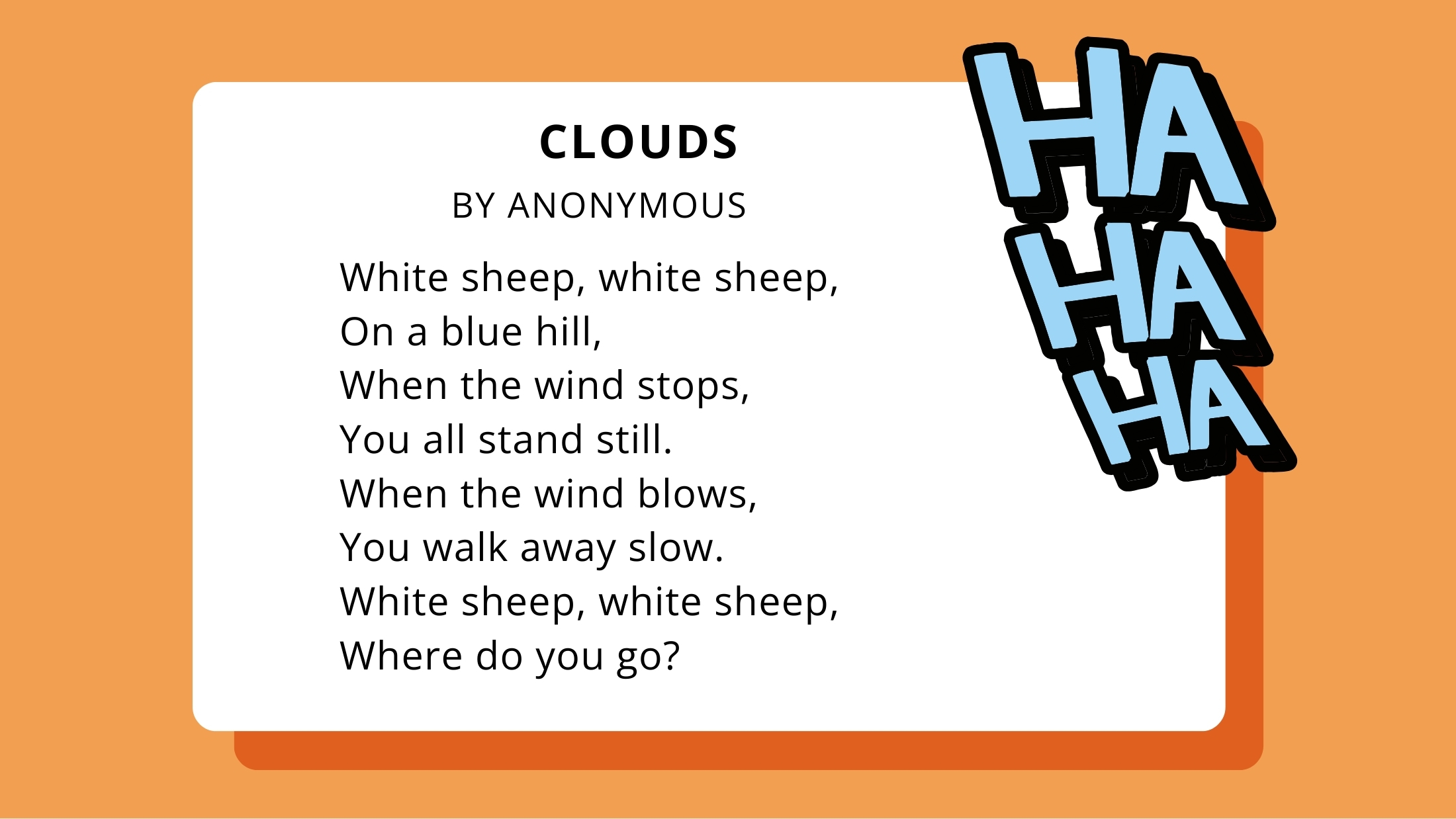
17. Clouds by Anonymous
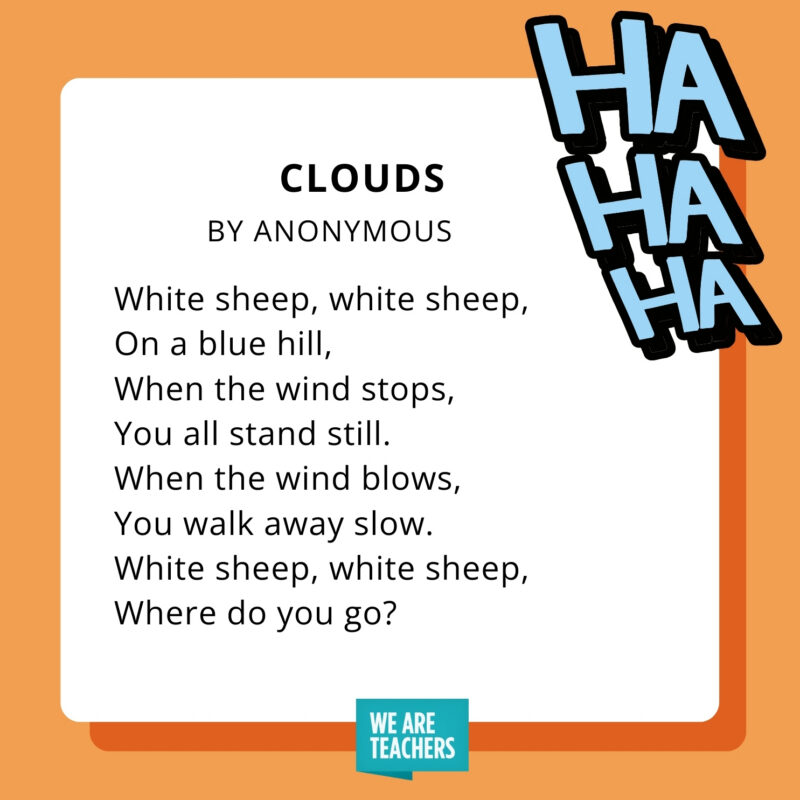
“White sheep, white sheep
On a blue hill.”
Themes: Nature, animals, wonderment
Literary devices: Imagery, rhyme, enjambment
This poem reads like a nursery rhyme, and its simplicity makes it a good one to introduce students to poetry. They can talk about the images that the poet creates with just a few words.
18. The Nest by Jessica Amanda Salmonson
“Have you heard
about the bird
Who built a nest
with zeal and zest?”
Themes: Competition, wildlife
Literary devices: Rhyme, alliteration, enjambment
Any student who has younger siblings can likely relate to this poem. It’s also a good one to use to talk about word choice and how word repetition contributes to a poem’s meaning.
19. Math Blues by Cindi Rockwell
“They try to give math a happier spin
‘How many times can this number go in?’”
Themes: School, math, humor
Literary devices: Rhyme, enjambment
Who says you can’t use math in poetry? This poem is a fun one to use when students express frustration with math. Can they create their own math blues poem?
20. Homework by Mariam Traore
“Homework, oh homework
All kids say it stinks …”
Themes: Homework, school, humor
Literary devices: Rhyme
The ending question, “Don’t you?” throws the rest of the poem into question. It’s a great example of how a poem can set up a premise and then bring it all into question with a twist ending.
21. My Doggy Ate My Essay by Darren Sardelli
“My doggy ate my essay.
He picked up all my mail.”
Themes: Homework, absurdity, pets
Literary devices: Rhyme, personification, enjambment
Another poem about homework that has a twist ending. Read this one and talk about how poets can create short stories one line at a time.
22. The Parakeets by Alberto Blanco
“They talk all day
and when it starts to get dark”
Themes: Pets, humor
Literary devices: Punctuation, repetition, personification, enjambment
How are the parakeets like your students? The more talkative a class you have, the more funny this poem will be. A great opportunity to talk about how poetry can connect with real life.
23. Mother Doesn’t Want a Dog by Judith Viorst
“Mother doesn’t want a dog.
Mother says they smell …”
Themes: Humor, pets
Literary devices: Rhyme, anaphora, refrain, enjambment
This poem is fun to read aloud, as it has a clear rhyming structure. It’s also a good example of how poets structure funny poems to throw out a punchline in the last stanza.
24. Now We Are Six by A.A. Milne
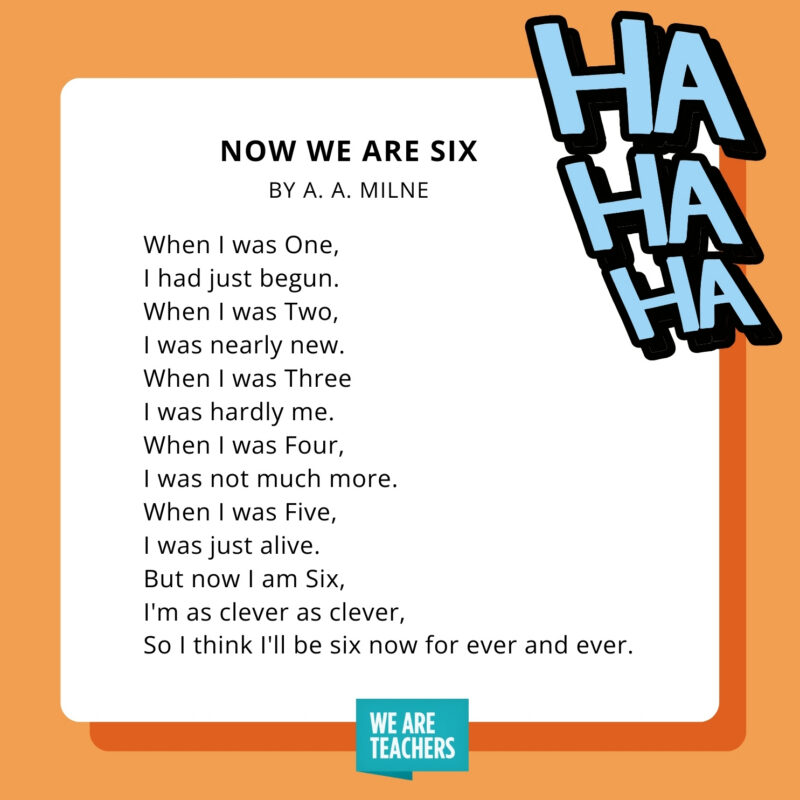
“When I was One,
I had just begun.”
Themes: Growing up, ages
Literary devices: Progression, rhyme, repetition
This sweet ode to childhood was written by the creator of Winnie the Pooh. Students can think about what Milne is saying about childhood, and how he uses structure to create a poem that sounds like it was written by a 6-year-old.
25. Help Wanted by Timothy Tocher
“Santa needs new reindeer.
The first bunch has grown old.”
Themes: Humor, holidays, Santa Claus and his reindeer
Literary devices: Allusion, rhyme, personification
A great poem to read during the holidays, Tocher imagines what might happen if Santa needed to recruit more reindeer. In terms of teaching, talk about the background knowledge students bring to the poem that makes it funny.
26. Summer Camp Souvenirs by Richard Thomas
“When I got home from camp today
My parents almost died.”
Themes: Camp, humor, being accident-prone
Literary devices: Rhyme, hyperbole
The dismissive, ambivalent tone of this poem is what makes it funny. Talk about how the poet uses phrases like “The poison ivy’s not too bad” and “And all these bruises, scabs, and cuts? I haven’t got a clue” to make the poem more silly than serious.
27. Adventures of Isabel by Ogden Nash
“Isabel met an enormous bear
Isabel, Isabel, didn’t care”
Themes: Humor, bravery
Literary devices: Repetition, rhyme, juxtaposition, personification
“Adventures of Isabel” reads like a fairy tale in poem form. Analyze how the poet creates absurd scenes using familiar fairy-tale characters.
28. Sarah Cynthia Sylvia Stout Would Not Take the Garbage Out by Shel Silverstein
“She’d scour the pots and scrape the pans,
Candy the yams and spice the hams …”
Themes: Humor, responsibility, chores, absurdity
Literary devices: Alliteration, hyperbole, imagery, rhyme
Another classic Silverstein funny poem, this one is about a girl who refuses to take the garbage out until it reaches the ceiling and takes over the floor. It’s the imagery and absurdity of the situation, as well as the rhymes, that makes this poem giggle-worthy.
29. Eletelephony by Laura Elizabeth Richards
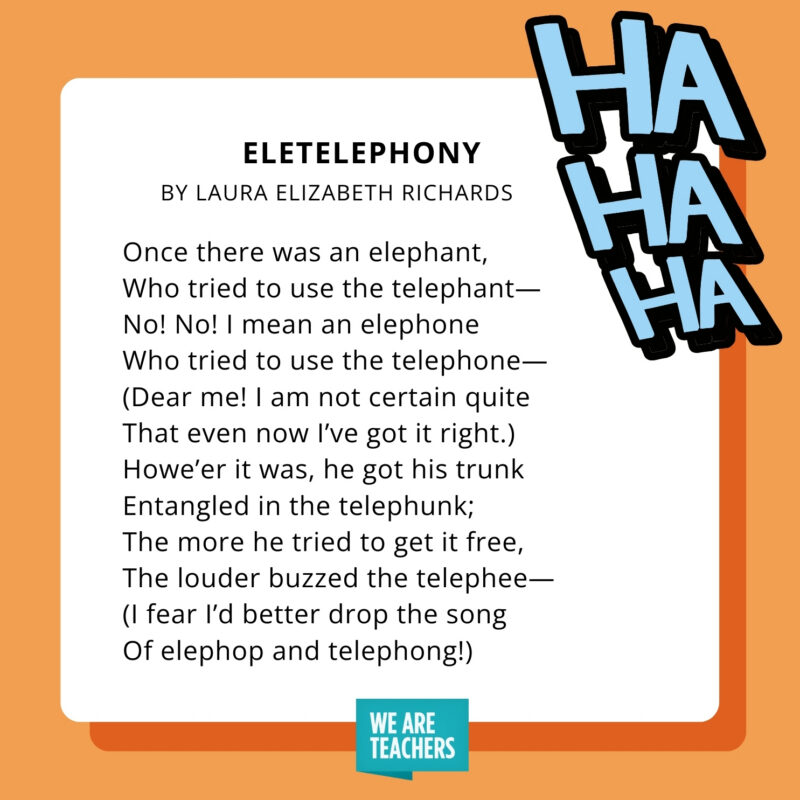
“Once there was an elephant,
Who tried to use the telephant—”
Themes: Silliness
Literary devices: Wordplay, rhyme
This imaginative poem about what would happen if an elephant used the telephone is a fun one to read with today’s kids as they try to imagine not only elephants, but old-fashioned telephones. The wordplay depicts a frustration with trying to tell the story at all.
30. The Dentist and the Crocodile by Roald Dahl
“The crocodile, with cunning smile, sat in the dentist’s chair.”
Themes: Absurdity, humor
Literary devices: Narrative, rhyme, personification
Did students know that Roald Dahl wrote poetry too? His poem “The Dentist and the Crocodile” has all the humor of Dahl’s novels, with an exchange between a dentist and a crocodile who have very different goals.
31. Daddy Fell Into the Pond by Alfred Noyes
“Everyone grumbled. The sky was gray.
We had nothing to do and nothing to say.”
Themes: Absurdity
Literary devices: Contrast, repetition, personification
This poem shows how a dismal day can be turned around by one funny event. Talk about juxtaposition and how the poet sets up two contrasting situations to create the humor.
32. The Vulture by Hilaire Belloc
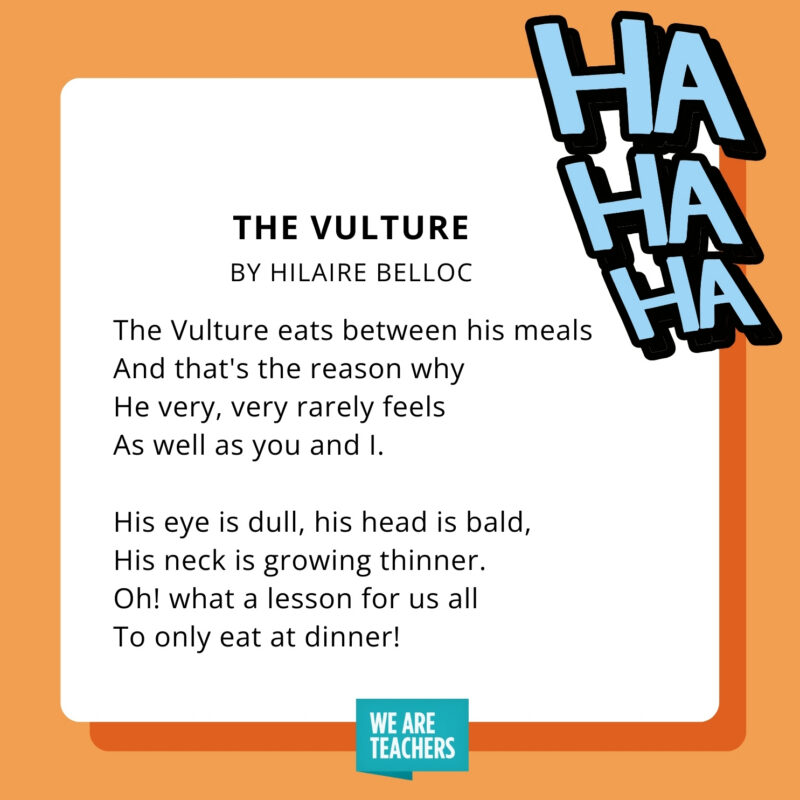
“The Vulture eats between his meals
And that’s the reason why …”
Themes: Animals, absurdity
Literary devices: Rhyme, personification
This classic poem uses humor to get to the moral of not eating between meals. Use it to discuss the best way to “teach” kids through literature.
33. The Silliest Teacher in School by Darren Sardelli
“Our teacher gave detention
to the fountains in the hall.”
Themes: School, humor, poor eyesight
Literary devices: Rhyme scheme, narrative, enjambment
This poem, about a teacher who makes mistakes until the principal points out her biggest mistake, is a good one to read with students who are learning how to follow poems that tell stories. In this case, you have to read to the end to fully get the joke.
34. Boa Constrictor by Shel Silverstein
“I’m being eaten by a boa constrictor,
And I don’t like it one bit.”
Themes: Humor, absurdity, dangerous animals
Literary devices: Rhyme, imagery, repetition
This poem, which can also be sung, is funny both because of the ending and because of the way it rhymes up until the Ummmph!
35. Nonsense Alphabet by Edward Lear
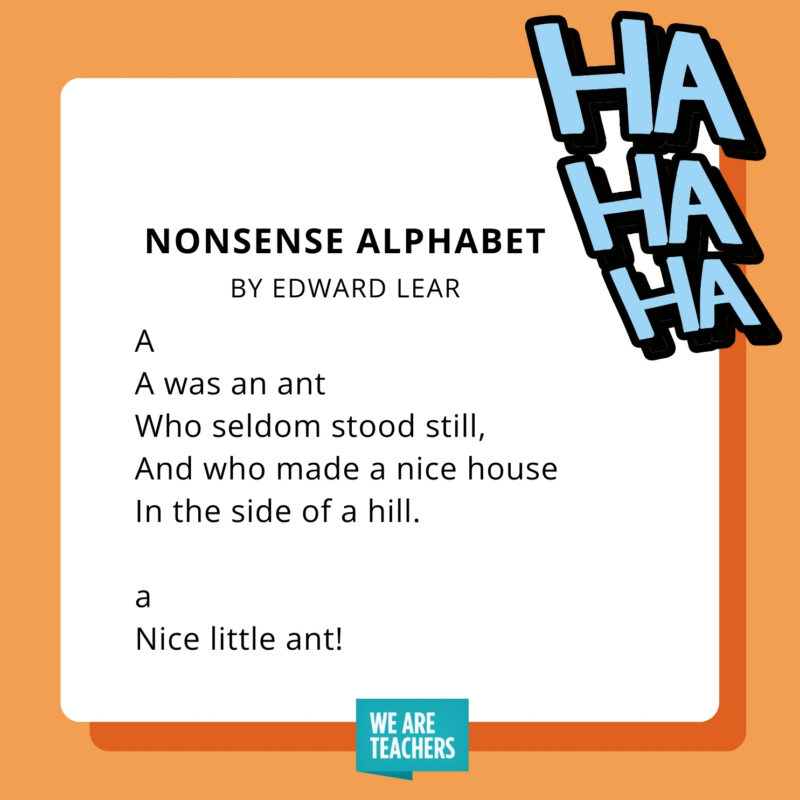
“A was an ant
Who seldom stood still
And who made a nice house
In the side of a hill.”
Themes: Fun
Literary devices: Rhyme, wordplay
Edward Lear’s writing is pure silliness. You can read this alphabet poem in its entirety or choose parts to focus on. Either way, it’s a fun way to practice fluency and talk about the various scenes that Leer creates for each letter.
36. How To Paint a Wall by Joanna Fuchs
“While I went off to work one day,
She decided to paint the wall”
Themes: Humor, absurdity
Literary devices: Narrative, rhyme
Language and the nuances of language are at the heart of funny poems. This is a great example of that, when someone decides to paint a wall and “puts on two coats.”
37. Working From Home by Phil J. Johnson
“The grass needs cutting,
I must mend the gate.
I’m expecting a parcel,
I hope it’s not late.”
Themes: Humor, working, chores
Literary devices: Repetition, rhyme
Students can analyze the structure of this poem—a list with a common ending line. And they can create their own poems about the challenges of doing homework or logging into online classes on a snow day.
38. Our Imperfect Dog by Cynthia Naspinski
“We love our dog with all our hearts,
But not so much her stinky farts.”
Themes: Pets, humor, love, acceptance
Literary devices: Hyperbole, rhyme
This poem is more complicated than the title lets on. Use it to analyze, line by line, what the poet is telling us about her dog that “wages war with the lawnmower” and “to baths she has a strong aversion.” The humor comes in the dog’s antics and the question: Will the family still love her?
39. Pizza the Size of the Sun by Jack Prelutsky
“I’m making a pizza the size of the sun
a pizza that’s sure to weigh more than a ton”
Themes: Absurdity, favorite food
Literary devices: Hyperbole, rhyme, simile
In “Pizza the Size of the Sun,” Prelutsky imagines what it would take to make a pizza with mountains of cheese that would take a year and a half to bake. The pizza lovers in your class will have fun imagining what it would be like to dig into this enormous pie.
40. The Eagle by Lord Tennyson
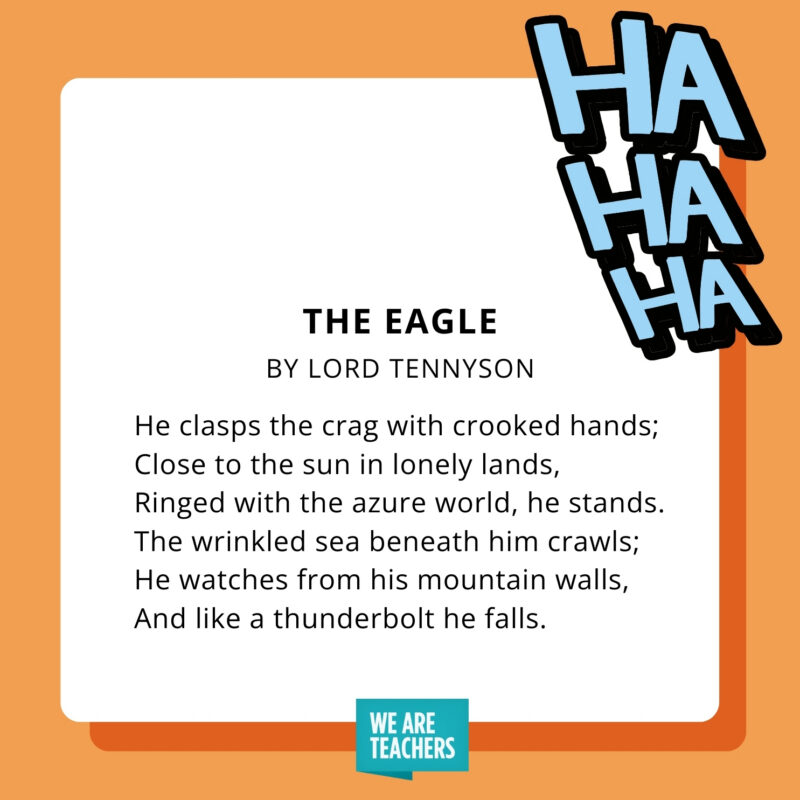
“He clasps the crag with crooked hands;
Close to the sun in lonely lands …”
Themes: Animal behavior
Literary devices: Rhyme, imagery, personification
This short poem is great to use as a warm-up or quick mini-lesson on imagery or rhyme. Students can create images to show the eagle, or read this poem alongside articles about eagles.
41. The People Upstairs by Ogden Nash
“The people upstairs all practise ballet
Their living room is a bowling alley …”
Themes: Humor, noisy neighbors
Literary devices: Contrast, rhyme, symbolism, hyperbole
Read this poem and talk about the vocabulary (“abate,” “conducted”) and imagine what experiences the poet had to inspire this poem.
42. Messy Room by Shel Silverstein
“Whosever room this is should be ashamed!
His underwear is hanging on the lamp.”
Themes: Chores, humor
Literary devices: Contrast, rhyme
This poem by Shel Silverstein uses the classic technique of building a scene and then turning it back onto the reader. Whose room is this? Oh, it’s mine!
43. Yes, I’ll Marry You, My Dear by Pam Ayres
“Yes, I’ll marry you, my dear and here’s the reason why;
So I can push you out of bed when the baby starts to cry …”
Themes: Humor, relationships
Literary devices: Rhyme
Older students can see the humor in this poem about the dual roles in a relationship, and the sometimes unequal tasks in a marriage. Note: This poem is written for an older audience.
44. The Purple Cow by Gelett Burgess
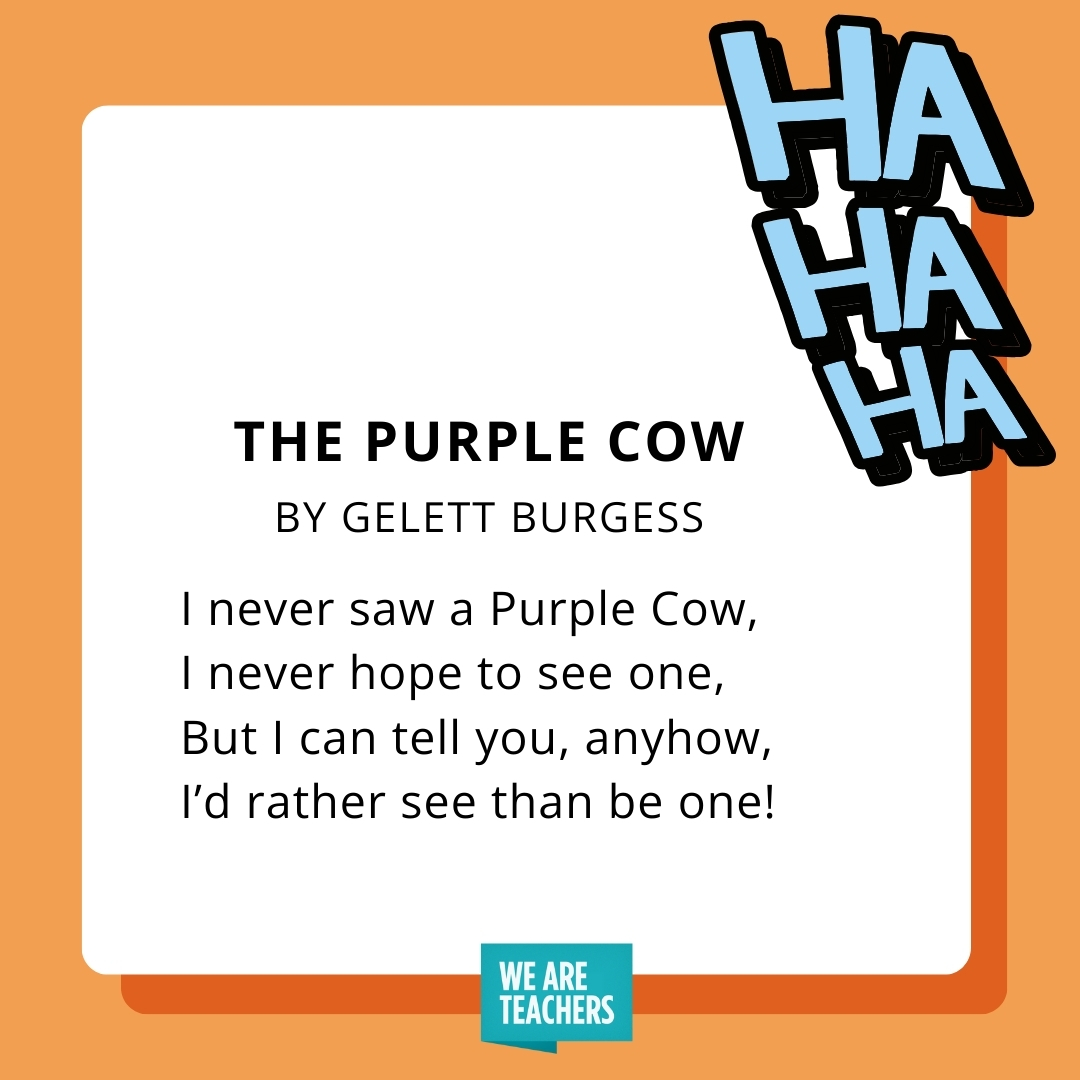
“I never saw a Purple Cow
I never hope to see one …”
Themes: Humor, absurdity
Literary devices: Rhyme
This poem reads like a nursery rhyme for older kids. Talk about how a short poem can create a clear image and be memorable.
45. Granny by Spike Milligan
“Through every nook and every cranny
The wind blew in on poor old Granny …”
Themes: Humor, wind
Literary devices: Imagery, rhyme
Use this poem to talk about how poets use repetition to build a stanza line by line. You can also talk about the silly images that the poet creates in this poem about a windy day and his granny.
46. Eating Habits by Alan Balter
“Tomato sauce I’m at a loss
I simply don’t know why …”
Themes: Food, humor
Literary devices: Imagery, rhyme
This poem is about how clothing never stands a chance against food, from tomato sauce to cheese. It’s a great read, especially if you have a class that can relate to the feeling of always having stains that seem to appear after lunch.
47. Monosyllabics by Laura Richards
“The black cat sat
In the fat man’s hat …”
Themes: Animals
Literary devices: Rhyme, enjambment
This poem is an easier read than its title suggests. It’s written with words with one syllable, which means that it’s a good one to use with younger students who can decode most of the words to build comprehension as they read.
8. Dream Variations by Langston Hughes
“To fling my arms wide
In some place of the sun,
To whirl and to dance
Till the white day is done.”
Themes: Freedom, joy, imagination, race
Literary devices: Repetition, imagery
Even young readers can read Langston Hughes, and this light, energetic poem is a great way to introduce students to the legendary American poet.
49. Kid, this is the first rain by Jeffrey Bean
“of November. It strips off the rest
of the leaves, reminds trees
how to shiver.”
Themes: Environment, nostalgia
Literary devices: Imagery, tone, enjambment
This is a more complicated poem for younger kids to read, but it’s worth spending some time to analyze this poem. Students can develop background knowledge that helps them understand the poem, which was inspired by the poet’s childhood in the 1980s.
50. The Shapes of Leaves by Arthur Sze
“Ginkgo, cottonwood, pin oak, sweet gum, tulip tree:
our emotions resemble leaves and alive
to their shapes we are nourished.”
Themes: Nature, connection
Literary devices: Symbolism, tone, imagery
Use this poem about observing trees and feeling connection to trees to engage students in creating their own poems based on observations of trees or other natural elements.
Ideas for Using Funny Poems in the Classroom
If you include picture books, which are often lyrical, students have been exposed to lots of poetry. Still, seeing those poems on the page can feel either intimidating or underwhelming. Use these activities to make poetry your students’ favorite unit:
- Hook students with humor. Students may look at a poem and groan because of previous experiences they’ve had with poetry or because poetry feels too wishy-washy. Read a few hilarious poems aloud to get the poetry unit started and help students warm up to the genre.
- Get the most out of every joke. Support students’ analysis of poems with anchor charts and bookmarks with information about poetic devices. These tools support students’ ability to focus on the text as they read line by line.
- Make hilarious drawings. Poems are meant to be sensory. Have students imagine what’s happening in each poem and create a drawing that could go along with it—the funnier the better. Then, if there is an image for the poem, like Shel Silverstein’s “Sick,” compare students’ drawings with the original. Who drew it better?
- Create funny stories. If you are reading a narrative poem, have students turn the poem into a comic strip, story, letter, or another narrative. What happens to the story when you change the format?
- Let hilarity ensue. A poetry slam is a perfect way to practice fluency. Challenge students to get other classes to laugh with how they read a silly poem. What voices or intonation can they add to really hit that punchline?
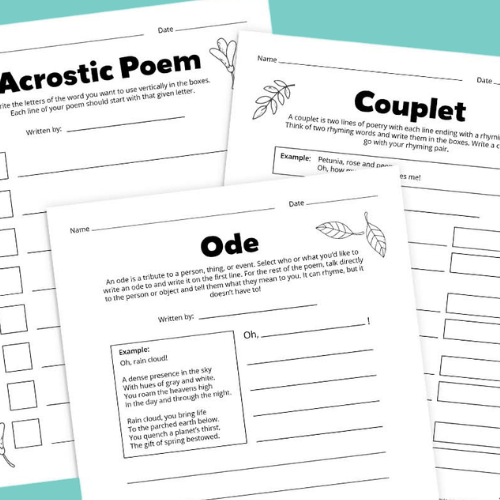
Get my printable poetry worksheet bundle!
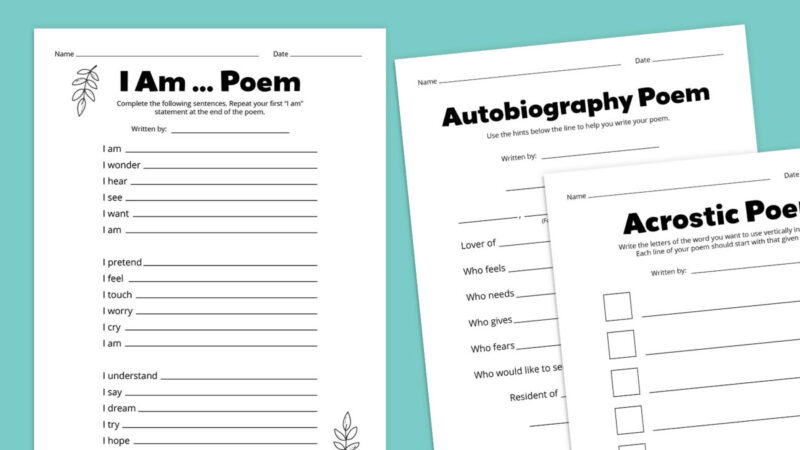
If you’re getting ready for a poetry unit, you’re going to want our poetry worksheet bundle featuring eight different styles of poetry. Click the button below and fill out the form to get it.
If you liked these poems, check out our must-share poems for elementary school students.
Source link
#Hilariously #Funny #Poems #Read #Share

