



By: Rachel Sherman and Katie Yezzi
Across America, school districts pour immense resources into purchasing new curriculum to help boost student outcomes. Yet a critical piece of the school improvement puzzle is often overlooked: ensuring all educators—from classroom teachers to district superintendents—align their efforts with the design and demands of that curriculum.
In too many school districts, leaders are trained to manage, and teachers are trained in pedagogy, as if their work can’t intersect. Yet, when leaders know how to create structures for teachers to do the preparation necessary to implement curriculum, guide them to ensure access for all students and analyze work to inform coaching, schools transform faster. The same is true for teachers—when they’re deeply versed in the curriculum and have strong ongoing support, students can make meaningful gains. The fastest way to transform student learning is to cohesively support and train educators alongside leaders.
One year of solid growth
This approach is exactly what drove our work at Relay when we partnered with New York City’s District 18. In this district, 82% of students are economically disadvantaged, and the majority are students of color.
Over the course of a school year, Relay coaches worked closely with District 18 teachers and leaders to internalize and implement high-quality curriculum. We built on a foundation of prior leadership work that had focused on ensuring District 18 leaders saw themselves as instructional leaders and had the tools to develop teachers.
Principal Rick Romain supporting instruction following a shared third grade planning meeting.
In our work, we prioritized leaders learning alongside classroom teachers to build everyone’s understanding of the curriculum. This made it possible for leaders to observe, facilitate and provide feedback in planning meetings—ultimately setting teachers and students up for success. The results were nothing short of impressive.
How we did it
To make this transformation possible, we leaned on three core tenets: creating instructionally fluent leaders, building aligned capacity across full teams, and developing long-term sustainability. With distinct but complementary plans of support at the district, principal, and teacher levels, we were able to expedite student results.
Instructionally fluent leaders
Strong results are made possible by strong, instructionally fluent leadership. In many schools today, the leadership is simply not up-to-speed enough in classroom instruction to deliver the feedback necessary to help teachers improve. A principal may typically observe teachers and give surface-level feedback on pedagogical moves. But when they are comfortable with the curriculum, they can provide curriculum-embedded feedback that pushes teacher development and thus student results at a higher rate.
We coached school leaders to understand curriculum-based instructional practice. When they can model what excellent teaching looks like, teachers follow. District 18’s progress shows what happens when leaders receive direct, consistent coaching focused on how to learn to plan with all students in mind, without lowering the bar.
We started with the district literacy team, including senior district leaders. This team engaged in internalization protocols teachers would be asked to use in order to deeply understand the curriculum and the systems and structures required for teachers to complete this process regularly. From there, this experience was shared with principals, who were able to similarly reflect on their campus’ systems and schedules to ensure ample adult learning time for their teachers to practice with their new resources.
Building aligned capacity
Of course, school leaders aren’t the only adults in a school building—the work simply cannot stop with them. Building aligned capacity across teacher, school leader, and district levels is necessary to achieve consistency and coherence.
In District 18, Relay was able to support teachers and leaders. We focused on coaching teachers to internalize lessons and teach using the new curriculum with integrity, while leveraging instructional leadership skills in school and district leaders so they could best support teachers. This throughline—from district to leader to classroom—helped eliminate siloed work environments and accelerate results.
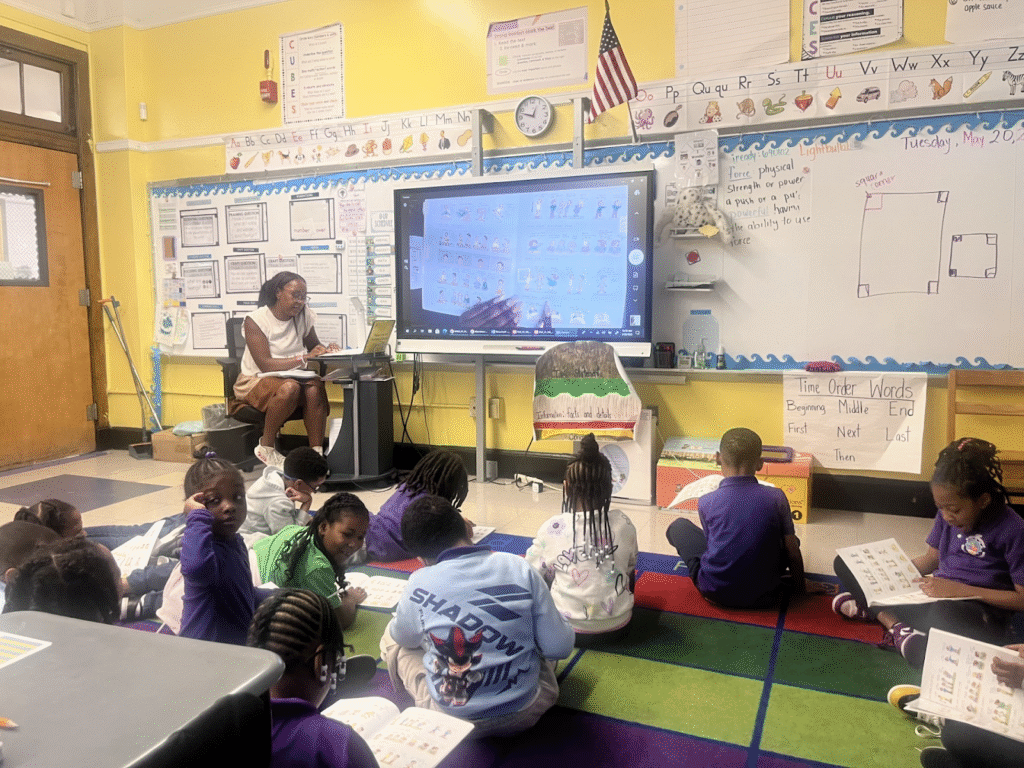
Ms. Dyer’s classroom was so excited to read Feelings and loved exploring the illustrations!
When new training was offered to teachers—for example, how to increase access for multilingual learners—principals and other building and district-level leaders would participate alongside their teacher teams so everyone received the content together.
Relay coaches would follow up with leaders—how to coach and provide ongoing support in this area with their teachers—and with the teachers themselves—observing and offering model feedback or additional practice, as needed. Finally, regular district-level touchpoints helped incorporate data to ensure our plan of action met the specific needs of the adults in the district, as opposed to a stock approach to development.
Unlike school districts where multiple vendors or consultants pull teams in different (sometimes disparate) directions, having a single aligned system made us all row in the same direction. Gains that often take three to five years were seen in just one, because alignment was prioritized. But simply because gains happen fast doesn’t mean we shouldn’t prepare for the longer term.
Developing sustainability
If the goal is long-term capacity—rather than long-term dependency—coaching should be designed to evolve over time, ultimately shifting responsibility to school leaders. True sustainability comes when school leaders can carry the work on their own.
By year three of a transformation like this, school leaders should be able to analyze student data, identify instructional gaps, and lead their own teams effectively. School transformation can and should be designed with an ultimate goal of leadership being able to replicate success on their own.
Since Relay focused on building leader capacity alongside teacher capacity, it was important for our coaches to implement a gradual release strategy. For example, if Relay coaches are working alongside a teacher to improve their pacing within the lesson, leaders are joining with key “look fors” around our coaching. The next visit, the leader will provide support and receive feedback from a Relay coach, ultimately empowering the leader to coach pacing issues independently.
Flipping the model
We lean on these tenets because of a profoundly different approach to transform student learning. Most curriculum providers are teacher-focused—Relay is focused on a comprehensive, cohesive approach.
Curriculum vendors often train teachers but rarely equip school leaders to effectively lead instruction. We flip that model and support educators at all levels. With this approach, we create a school more aligned in its implementation of high-quality instructional materials, teacher coaching, and data use.
From 2024 to 2025, District 18’s English Language Arts proficiency rate rose by 11.1 points—nearly closing the gap with the citywide average. Across almost every grade level, students showed significant growth, with fifth graders making the largest gains at 27.1 percentage points, outpacing their peers across the city. And District 18 posted the most growth of any NYC Reads district in their first year of implementing the high-quality curriculum, with elementary schools alone improving by 18.3 points.
District 18’s impressive gains underscore what happens when a system chooses an implementation plan that provides cohesive support and development at all levels in a district—rather than treat them as siloed. When we can get school leaders closer to the classroom and deeply versed in instruction—and when we can get teachers to deeply understand their resources and have ongoing support—student growth and strong outcomes follow.
Rachel Sherman is a seasoned education leader with over 15 years of experience driving instructional excellence and equity across schools and districts. She has led transformative HQIM implementation efforts at the school and system levels—most recently as Partner of Professional Education at Relay Graduate School of Education, where she designs and manages Curriculum Support programs that build sustainable, data-driven instructional systems grounded in HQIM.
Katie Yezzi has spent over 30 years working to improve K-12 public schools and currently serves as Senior Partner on the Customized Coaching and Training team at Relay GSE. She has taught English/Humanities, served as English department head, Assistant Principal, Founding Principal, and Assistant Superintendent in district and charter schools.
Previous version:
The fastest way to transform learning isn’t just purchasing curriculum—it’s building alignment among educators at all levels
By Rachel Sherman and Katie Yezzi
Across America, school districts pour immense resources into purchasing new curriculum to help boost student outcomes. Yet a critical piece of the school improvement puzzle is often overlooked: ensuring all educators—from classroom teachers to district superintendents—align their efforts with the design and demands of that curriculum.
In too many school districts, leaders are trained to manage, and teachers are trained in pedagogy, as if their work can’t intersect. Yet, when leaders know how to create structures for teachers to do the preparation necessary to implement curriculum, guide them to ensure access for all students and analyze work to inform coaching, schools transform faster. The same is true for teachers—when they’re deeply versed in the curriculum and have strong ongoing support, students can make meaningful gains. The fastest way to transform student learning is to cohesively support and train educators alongside leaders.
One year of solid growth
This approach is exactly what drove our work at Relay when we partnered with New York City’s District 18. In this district, 82% of students are economically disadvantaged, and the majority are students of color.
Over the course of a school year, Relay coaches worked closely with District 18 teachers and leaders to internalize and implement high-quality curriculum. We built on a foundation of prior leadership work that had focused on ensuring District 18 leaders saw themselves as instructional leaders and had the tools to develop teachers.
In our work, we prioritized leaders learning alongside classroom teachers to build everyone’s understanding of the curriculum. This made it possible for leaders to observe, facilitate and provide feedback in planning meetings—ultimately setting teachers and students up for success. The results were nothing short of impressive.
How we did it
To make this transformation possible, we leaned on three core tenets: creating instructionally fluent leaders, building aligned capacity across full teams, and developing long-term sustainability.
Instructionally fluent leaders
Strong results are made possible by strong, instructionally fluent leadership. In many schools today, the leadership is simply not up-to-speed enough in classroom instruction to deliver the feedback necessary to help teachers improve. A principal may typically observe teachers and give surface-level feedback on pedagogical moves. But when they are comfortable with the curriculum, they can provide curriculum-embedded feedback that pushes results at a higher rate.
We coached school leaders to understand great instructional practice. When they can model what excellent teaching looks like, teachers follow. District 18’s progress shows what happens when leaders receive direct, consistent coaching focused on how to learn to plan with all students in mind, without lowering the bar.
Building aligned capacity
Of course, school leaders aren’t the only adults in a school building—the work simply cannot stop with them. Building aligned capacity across teacher, school leader, and district levels is necessary to achieve consistency and coherence.
In District 18, Relay was able to support teachers and leaders. We focused on coaching teachers to internalize lessons and teach using the new curriculum with integrity, while leveraging instructional leadership skills in school and district leaders so they could best support teachers. This throughline—from district to leader to classroom—helped eliminate siloed work environments and accelerate results.
Unlike school districts where multiple vendors or consultants pull teams in different (sometimes disparate) directions, having a single aligned system made us all row in the same direction. Gains that often take three to five years were seen in just one, because alignment was prioritized. But simply because gains happen fast doesn’t mean we shouldn’t prepare for the longer term.
Developing sustainability
If the goal is long-term capacity—rather than long-term dependency—coaching should be designed to evolve over time, ultimately shifting responsibility to school leaders. True sustainability comes when school leaders can carry the work on their own.
By year three of a transformation like this, school leaders should be able to analyze student data, identify instructional gaps, and lead their own teams effectively. School transformation can and should be designed with an ultimate goal of leadership being able to replicate success on their own.
Flipping the model
We lean on these tenets because of a profoundly different approach to transform student learning. Most curriculum providers are teacher-focused—Relay is focused on a comprehensive, cohesive approach.
Curriculum vendors often train teachers but rarely equip school leaders to effectively lead instruction. We flip that model and support educators at all levels. With this approach, we create a school more aligned in its implementation of high-quality instructional materials, teacher coaching, and data use.
From 2024 to 2025, District 18’s English Language Arts proficiency rate rose by 11.1 points—nearly closing the gap with the citywide average. Across almost every grade level, students showed significant growth, with fifth graders making the largest gains at 27.1 percentage points, outpacing their peers across the city. And District 18 posted the most growth of any NYC Reads district in their first year of implementing the high-quality curriculum, with elementary schools alone improving by 18.3 points.
These impressive gains underscore what happens when a system chooses an implementation plan that provides cohesive support and development at all levels in a district.
District 18’s story shows what’s possible when school systems prioritize and invest in all levels of a district—rather than treat them as siloed. When we can get school leaders closer to the classroom and deeply versed in instruction—and when we can get teachers to deeply understand their resources and have ongoing support—student growth and strong outcomes follow.
Rachel Sherman is a seasoned education leader with over 15 years of experience driving instructional excellence and equity across schools and districts. She has led transformative HQIM implementation efforts at the school and system levels—most recently as Partner of Professional Education at Relay Graduate School of Education, where she designs and manages Curriculum Support programs that build sustainable, data-driven instructional systems grounded in HQIM.
Katie Yezzi has spent over 30 years working to improve K-12 public schools and currently serves as Senior Partner on the Customized Coaching and Training team at Relay GSE. She has taught English/Humanities, served as English department head, Assistant Principal, Founding Principal, and Assistant Superintendent in district and charter schools.
Source link
#fastest #transform #learning #isnt #purchasing #curriculumits #building #alignment #among #educators #levels

