


MEXICO CITY — Mexican authorities have killed one of the world’s most wanted drug traffickers, Nemesio Rubén Oseguera Cervantes, known as “El Mencho,” founder and leader of the notorious Jalisco New Generation cartel, which controls drug smuggling, extortion, fuel theft and other rackets throughout Mexico.
Oseguera, believed to be 59, suffered fatal wounds during a Sunday morning military assault in the town of Tapalpa in Jalisco state, according to the Mexican Defense Ministry. He died while being airlifted to Mexico City for medical treatment along with other cartel associates injured in the raid, the military said.
Six other cartel operatives were also killed in the operation, the military said, and three soldiers were injured.
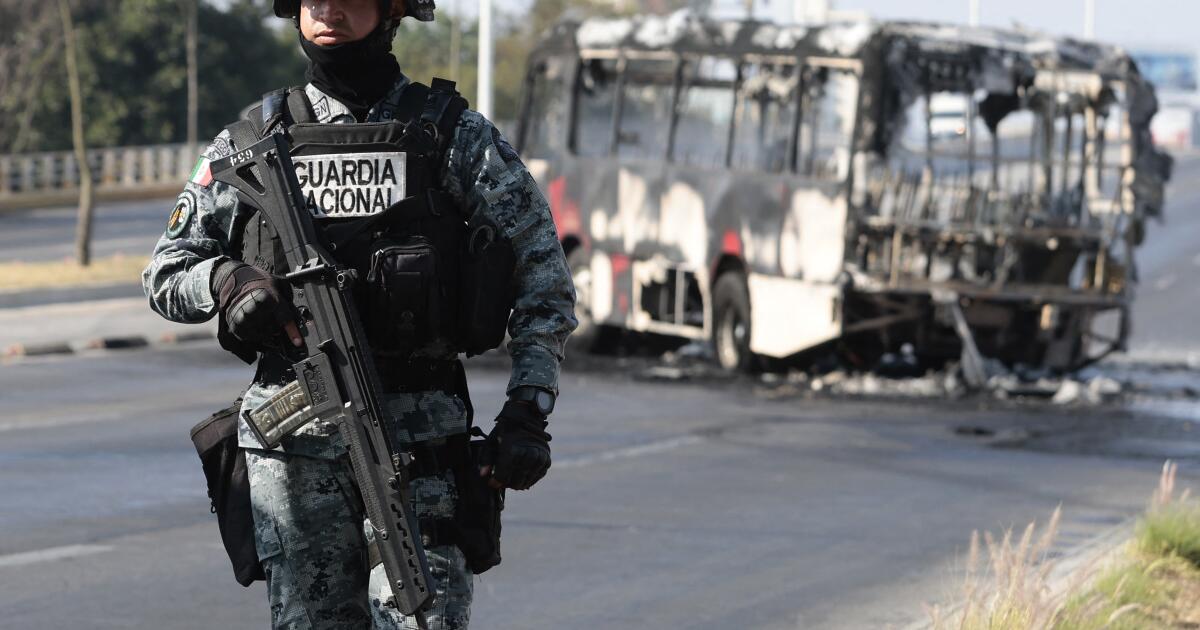
The drug kingpin’s killing also triggered violence. As the news spread, apparent supporters of the late cartel boss set fires to vehicles and blocked roads across western Mexico, prompting fears of escalating chaos in coming days and weeks.
Oseguera’s death is the most significant takedown of a Mexican capo since the 2016 capture of Joaquín “El Chapo” Guzmán, former head of the Sinaloa cartel. El Chapo was extradited to the United States and is serving a life sentence in a U.S. prison.
The operation comes as the government of Mexican President Claudia Sheinbaum has been under intense pressure from the Trump administration to crack down on U.S.-bound drug trafficking.
In a brief reaction, Sheinbaum applauded the military and security services and urged people to remain calm amid TV and social media images of blockades, towers of smoke and torched vehicles.

An alleged photo of Nemesio Rubén Oseguera Cervantes, known as El Mencho, released by U.S. prosecutors.
(U.S. District Court)
“We must remain informed and calm,” she posted on X. “In the vast majority of the national territory, activities are proceeding with complete normality.”
Under Oseguera’s leadership, the Jalisco cartel has been on a relentless effort to extend its tentacles throughout Mexico, especially after the downfall of El Chapo, which weakened the once-dominant Sinaloa cartel.
Jalisco operatives have aggressively invaded the turf of other gangs, incorporated smaller criminal bands into its ranks and put legions of police officers, judges, prosecutors and politicians on its massive payroll.

A burned car near Guadalajara after the killing of drug lord Oseguera.
(Alejandra Leyva / Associated Press)
Though rumors circulated on social media that the American military was directly involved, U.S. authorities denied any such role. Sheinbaum has pledged “cooperation and coordination” with U.S. officials in anti-cartel actions, but has rejected any direct U.S. role on the ground in Mexico.
The takedown of Oseguera, the U.S. Embassy in Mexico City said, “was planned and executed by Mexican Special Forces” and “was carried out within the framework of bilateral cooperation.” U.S. authorities, the embassy said, provided “complementary intelligence.”
U.S. officials were quick to applaud Mexican authorities.
“This is a great development for Mexico, the US, Latin America and the world,” Christopher Landau, deputy secretary of State, said on X. “The good guys are stronger than the bad guys.”
Derek Maltz, the retired former acting administrator of the Drug Enforcement Administration under President Trump, described Oseguera as “one of the most dangerous narco terrorists in the world who’s responsible for killing historic amounts of Americans” — the latter a reference to U.S. citizens who have died of overdoses of smuggled drugs, notably fentanyl, the synthetic opioid.
Like other current and former U.S. law enforcement officials, Maltz praised Mexico’s recent campaign to ratchet up pressure against criminal groups. In the last year, Mexico has dispatched scores of suspected cartel operatives to the United States, where many face criminal charges.
“I applaud the efforts of the Mexican government and the brave warriors on the front line that have been going after [Oseguera] for many years,” Maltz told The Times. “He’s no longer able to destroy communities and families around America or terrorize the citizens of Mexico.”
The Jalisco cartel is among the Mexico-based mobs that the Trump administration has formally designated as foreign terrorist organizations.
But the designation has been viewed warily in Mexico: Many worry that the move could also be used to justify direct U.S. military action in Mexico — a step that Sheinbaum’s government has strenuously sought to avoid.
The death of Oseguera, like the previous takedowns of El Chapo and other cartel leaders, is unlikely to reduce the volume of drug-smuggling to the United States, experts said. The exit of kingpins in the past has never offset the lure of huge profits tied to the voracious appetite for illicit substances north of the border.
But many in Mexico and elsewhere feared the capo’s death could spark a deadly round of violence in the country, as lower-level cartel operatives fight for supremacy amid a leadership void. Deadly intra-cartel battles have previously followed the killings or arrests of other crime bosses in Mexico.
“Hopefully, this will not spiral out of control and generate an epidemic of violence nationwide,” Eduardo Guerrero, a security analyst, told Mexico’s Milenio news outlet. “I hope [the government] has thought about a plan to control this violence that could surge in various places.”
But there were already indications of a violent reaction, especially in western Jalisco, the capital of which is Guadalajara, Mexico’s second city.
A family sheltering in place in the state of Jalisco — whose members asked to not be identified because of safety concerns — said cartel members were pulling people out of vehicles in the street and setting the vehicles on fire. Cars, trucks and buses going up in flames were visible on roads in Guadalajara and Puerto Vallarta, according to video circulating on social media, as well as in the states of Nayarit and Michoacán.

A group of Jalisco New Generation Cartel fighters in the Mexican state of Michoacan.
(Juan Jose Estrada Serafin / Fo)
The governor of Jalisco reported roadblocks and other disturbances throughout the state and advised people to stay home.
There were also reports of roadblocks and shootouts in more than a dozen other states in Mexico where the cartel held sway.
U.S. authorities had offered a $15-million reward for information leading to the arrest or conviction of Oseguera. He was under indictment for drug trafficking and other crimes in U.S. federal court.
Oseguera oversaw a military-like buildup of his cartel, which pioneered the use of armored vehicles, land mines, drones and other military hardware. Among other attacks, the Jalisco gang was blamed for the 2015 downing of a Mexican military helicopter, which resulted in the deaths of nine Mexican law enforcement officials. The helicopter — reportedly hit with U.S.-made .50-caliber machine-gun rounds — was on a mission to capture the elusive cartel boss.
Oseguera was born in 1966 in Naranjo de Chila, a sun-bleached town with fewer than 500 residents in a region of Michoacán state known as the Tierra Caliente, or Hot Land. He dropped out of primary school to help his family cultivate avocados before migrating to the United States.
Oseguera is said to have begun his storied career in humble fashion, as a small-time drug dealer in California. A 1992 arrest for selling heroin to an undercover officer in a bar in San Francisco led to a U.S. prison term. He was deported to Mexico, became a police officer, and eventually built his own crime network, one known for its brutality.
Rumors about El Mencho’s death and capture have circulated in the past and turned out to be false. But in recent years, authorities appeared to be closing in, capturing several high-ranking associates and close family members.
His son, Rubén Oseguera González, known as “El Menchito,” was captured and extradited from Mexico in February 2020. He was convicted in 2024 on an array of drug and weapons charges related to his leadership role in the cartel and is serving a life sentence.
U.S. Bureau of Prisons records show he is housed at a maximum-security federal prison in Florence, Colo., known as the “Alcatraz of the Rockies,” that also houses “El Chapo” and other high-profile criminals.
His daughter, Jessica Johanna Oseguera González, was arrested while visiting one of her brother’s court proceedings and eventually pleaded guilty to violations of the so-called Kingpin Act related to money laundering. She reportedly spent just over two years in prison before her release in 2022.
Times staff writers McDonnell, Linthicum and Hamilton reported from Mexico City, New York and San Francisco, respectively. Special correspondent Cecilia Sánchez Vidal in Mexico City contributed to this report.
Source link
#Mexican #army #kills #Mencho #Mexicos #mostwanted #drug #kingpin

