


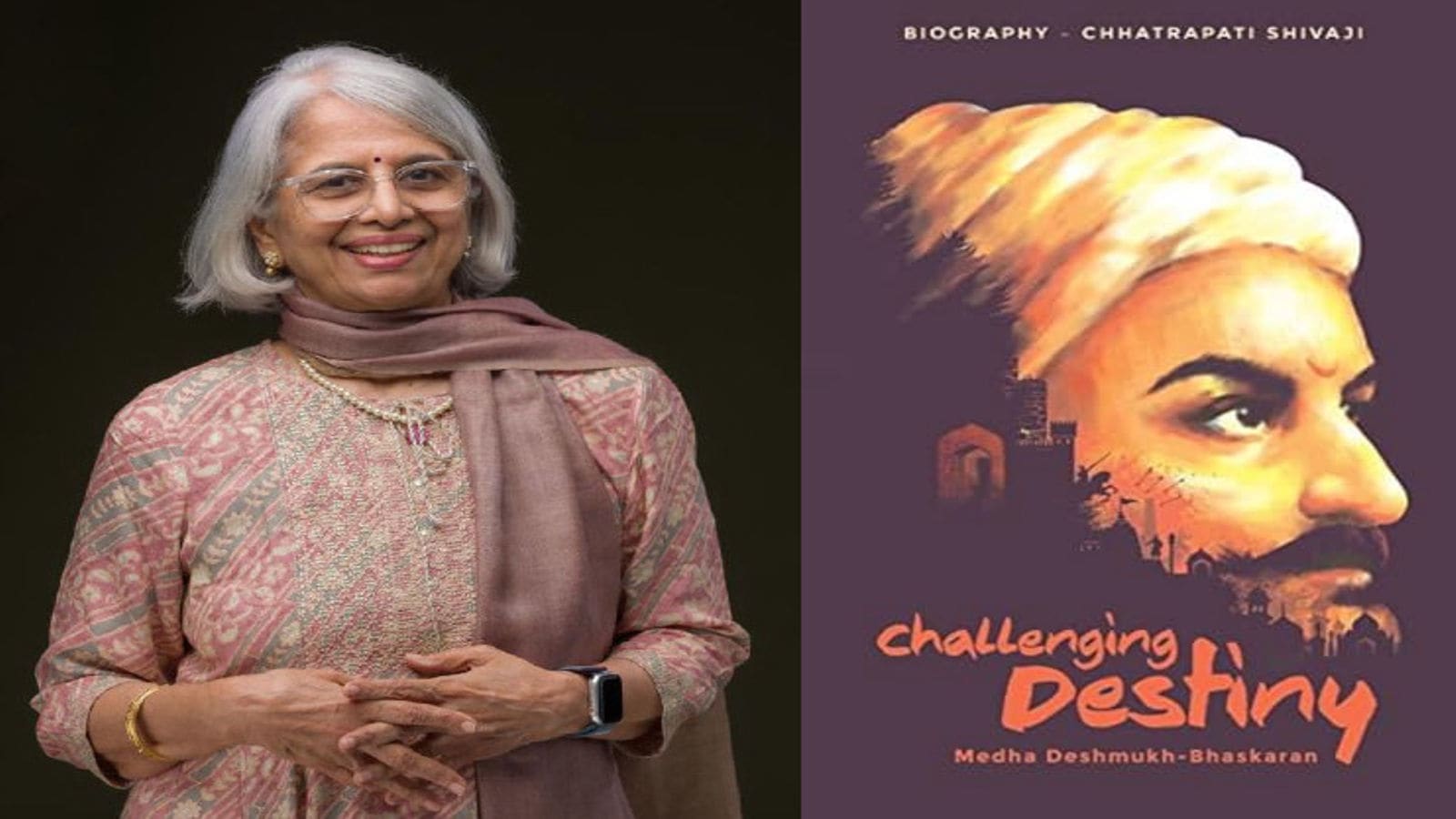
Before Medha Bhaskaran became an author, language itself was something she had to fight her way into. Writing did not arrive as talent or certainty; it arrived as struggle—slow, uneven, and persistent. Her life began not with ambition, but with movement: across cities, across languages, across expectations. Words first came to her in Marathi, carrying poetry, memory, and emotion long before English became a language she could claim.
She was a Marathi-medium student. English existed around her, but it did not belong to her yet. She remembers a moment from her Class 10 that stayed with her for decades. Her father sat with her over a poem by Robert Frost and asked her to understand its feeling before worrying about words—to translate it into Marathi. The exercise was difficult, awkward, and slow. “It was not about translation,” she recalls. “It was about meaning.” That insistence on emotion before language quietly shaped the writer she would become.
Her childhood moved with her father’s government postings—Ahmednagar, Ahmedabad, Nagpur, Mumbai. “My childhood was very cheerful,” she says. “That kind of pure happiness I never really got later in life.” Poetry entered early—Marathi first, English hesitantly. By sixteen, she could speak English, but without confidence. “I wasn’t fluent. But I was never scared of learning.”
Her curiosity for languages deepened when she began studying German at Max Mueller Bhavan, Pune. It was there that she met the man who would later become her husband. The decision to learn German was practical at first, but it quietly altered the course of her life.
At nineteen, she left India alone for Germany, at a time when very few Indian women did. She went to study microbiology, but Germany taught her far more than science. She worked in laboratories, cleaned cars, babysat, and picked grapes in vineyards. “Germany taught me dignity of labour,” she says. “No job is small if you do it honestly.” Those years taught her discipline, independence, and observation. She read widely, including books on the Holocaust. History, for the first time, began to feel personal.
Back in India, she entered the pharmaceutical industry, working across marketing, product management, and medical communication. The work was relentless—hours in medical libraries, constant travel, lectures for doctors, and training sales teams. Later, in the Gulf, she led public-health communication projects, conducting over a hundred seminars on dehydration and heat stress. Professionally, she was accomplished. Personally, stability remained elusive.
Journalism was her entry point
Story continues below this ad
In the UAE, despite experience, she struggled to find corporate work. Editors advised her to change her name to sound more “acceptable” for English publications. She refused. “I will write as Medha Bhaskaran, or I won’t write at all.” Journalism became her entry point. She went on to write hundreds of articles for Khaleej Times and Gulf News. “You cannot show off with words,” she says. “You have to connect.” Writing, she learned, was not performance—it was responsibility.
Historical writing arrived late, and with resistance. When she decided to write Challenging Destiny, she saw a silence few acknowledged. There was no full-length, narrative biography of Chhatrapati Shivaji Maharaj in English that ordinary readers could access. Existing works were either academic or distant. She was warned repeatedly. “You are not a historian,” people told her. She proceeded anyway.
Her scientific training shaped her method—rigorous sourcing, cross-verification, clarity over ornamentation. One conscious choice was translating seventeenth-century economics into present-day terms, converting monetary figures into US dollars. “The aim was not simplification,” she has said. “It was comprehension.”
The research took nearly 15 years. She wrote while raising children, managing a household, and freelancing. Rejection followed. So did ridicule. When Challenging Destiny finally appeared, it defied expectations—becoming a national bestseller, nominated for the Raymond Crossword Book Award, translated into multiple languages, and adapted for Audible. “I never thought of success,” she says. “I only thought of the truth.”
Story continues below this ad
Loss followed recognition. During the Covid lockdown, she lost her husband to cancer, alone in Bangalore.
“I asked myself—should I sit and cry, or should I research?” She chose research. Reading over 120 papers, she wrote The Story of Immunity, transforming grief into science that reached thousands of doctors.
Legal battles over ancestral land pulled her repeatedly to Ahmednagar courts. Instead of retreating, she encountered Snehalaya, a social organisation working with survivors of sexual violence. The experience became Up Against Darkness, later translated into Marathi and awarded the FICCI Publishing Award. “You can find an oasis even in chaos,” she reflects.
Today, Medha Bhaskaran writes across history, science, and social nonfiction. Her books travel languages and borders. Yet she remains rooted in humility. “I never planned my life,” she says. “Nothing I planned ever happened. And still—it was beautiful.”
Source link
#Odds #find #oasis #chaos #life #built #sentence #sentence

