


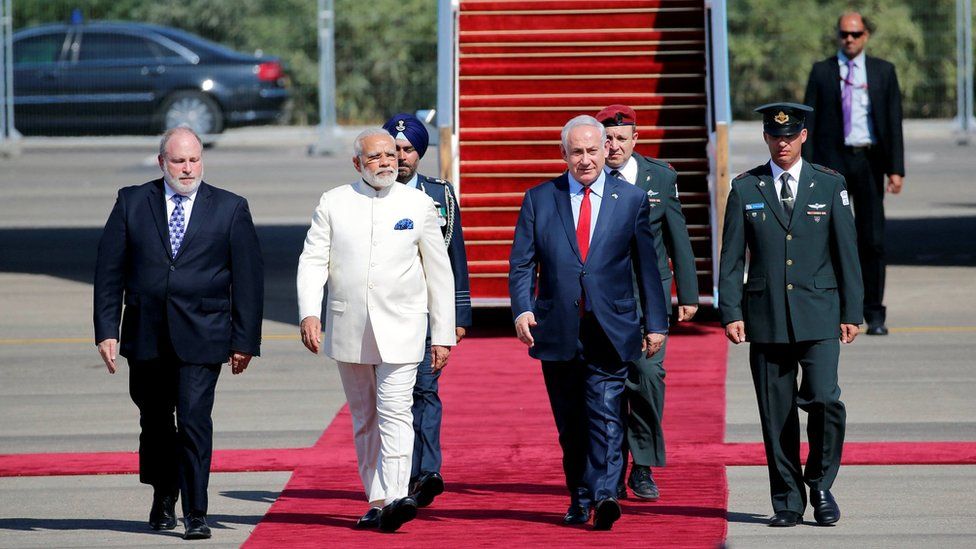
Prime Minister Narendra Modi’s recent strategic visit to Israel, the first by an Indian Prime Minister to the Jewish state, marks a significant recalibration of India’s foreign policy and underscores the deepening bilateral ties between the two nations. The visit, laden with diplomatic and economic implications, signals a new era of engagement that extends beyond defense cooperation to encompass innovation, technology, and agriculture.
The backdrop to this landmark visit is the long-standing, albeit historically complex, relationship between India and Israel. For decades, India maintained a cautious approach towards Israel, largely due to its non-aligned foreign policy and its historical ties with Arab nations. However, a gradual shift began in the early 1990s with the full diplomatic recognition of Israel by India. Since then, the relationship has steadily blossomed, particularly in the defense sector, where Israel has become a crucial supplier of advanced military hardware and technology to India. This visit, however, aimed to broaden the scope of this partnership, moving it into more visible and diverse areas.
During the three-day trip, Prime Minister Modi held extensive discussions with his Israeli counterpart, Benjamin Netanyahu, as well as President Reuven Rivlin. The agenda was packed, covering a wide array of bilateral issues, including trade, investment, cyber security, space exploration, and water management. Several significant agreements were signed, most notably in the areas of reducing cyber-attack vulnerabilities and enhancing cooperation in the agricultural sector, a field where Israel has made remarkable advancements. The emphasis on innovation and technology was palpable, with both leaders acknowledging the potential for joint ventures and research collaborations to drive economic growth and address mutual challenges.
A key takeaway from the visit was the shared vision for future cooperation. Both nations expressed a strong desire to leverage each other’s strengths, with India seeking Israeli expertise in areas like drip irrigation, desalination, and high-tech farming to boost its agricultural productivity, and Israel looking to tap into India’s vast market and skilled workforce. The discussions also touched upon strengthening ties in the defense industrial sector, moving beyond buyer-seller relationships towards joint development and manufacturing. This signals a maturing of the partnership, with an ambition to co-create solutions rather than simply procure them.
The implications of Prime Minister Modi’s visit are far-reaching. Strategically, it reinforces India’s growing assertiveness on the global stage and its willingness to forge partnerships based on shared interests, irrespective of traditional geopolitical alignments. For Israel, the visit is a major diplomatic coup, further cementing its standing in Asia and underscoring its growing importance as a technological and security partner. Economically, the potential for increased trade and investment is substantial, promising to benefit both economies. Furthermore, the visit signals a subtle yet significant recalibration of India’s Middle East policy, demonstrating a pragmatic approach that prioritizes strategic partnerships and economic opportunities. The successful conclusion of this visit is expected to pave the way for further high-level exchanges and a deeper, more multifaceted relationship between India and Israel in the years to come.

