


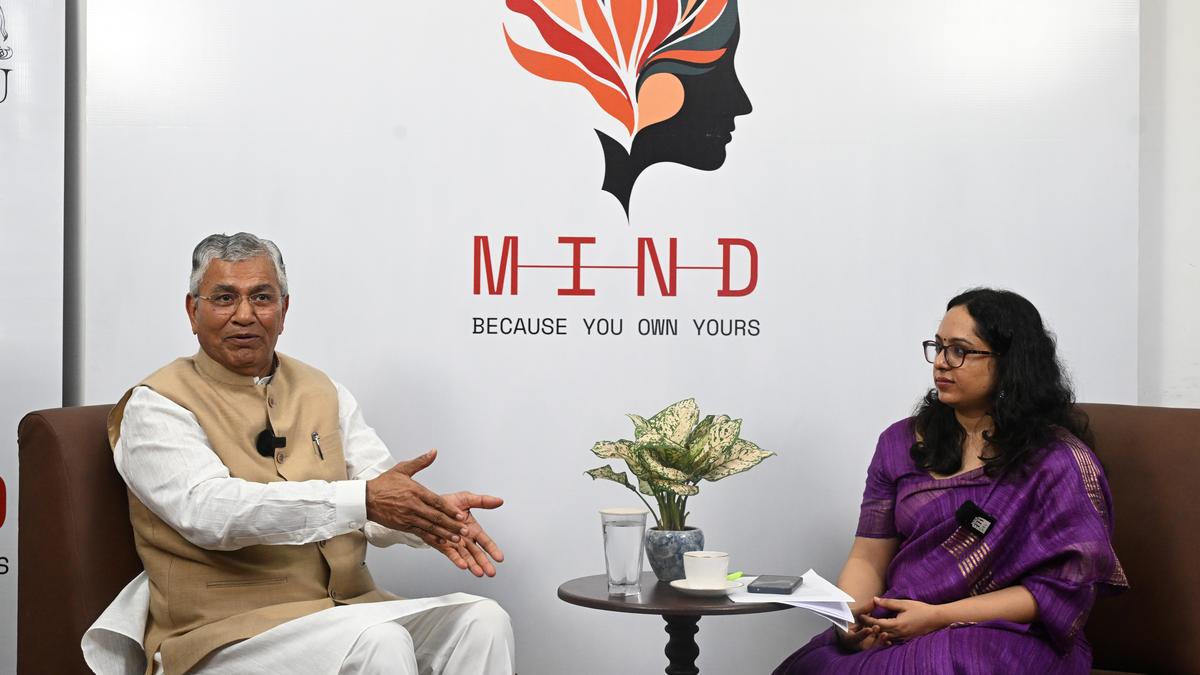

The JPC on simultaneous polls has had 16 meetings consulting a wide array of witnesses, including six former Chief Justices of India. You have made your support for the legislation very clear. Why do you believe India needs to synchronise its election cycle?

This reform is necessary from an economic standpoint to prevent wastage of manpower and to avoid disruption of investment. ‘One nation, one election’ is key for ‘Viksit Bharat’. In Uttarakhand, for instance, tourism accounts for 43% of the State’s revenue and operates effectively for only four months. An election held in April-May during this window severely disrupts the economy. Nationwide, separate voter lists for panchayat, municipal, Assembly and Lok Sabha elections must be prepared repeatedly, largely by government school teachers. Their frequent deployment for training and election duties disrupts teaching, hurting students, especially those from disadvantaged backgrounds. A paper presented to the Ram Nath Kovind Committee (an 8-member high-level panel on simultaneous elections) by [former Finance Commissioner] N.K. Singh and Prachi Mishra [economics professor] estimated a recurring loss of 1.6% of the GDP, roughly ₹7 lakh crore, due to frequent elections, a cost that could otherwise fund housing, infrastructure, and development. [Former IMF chief economist] Gita Gopinath has also acknowledged the economic impact. Elections cause investment delays, including FDI, as investors wait for political clarity at both the State and Central levels. Without at least four-and-a-half years of stable governance, meaningful outcomes cannot be delivered. If India aspires to become a developed nation by 2047, electoral reform is essential. To quantify the losses more accurately, the panel has asked Chief Secretaries of all States and Union Territories to study the impact of frequent elections.
There are two main criticisms of this legislation. Firstly, that it violates the basic structure of the Indian Constitution. Secondly, it is against the federal framework of the Constitution. After all, elections are the only way to hold the government accountable. What are your thoughts?
I have a question for those critics. From 1951 to 1967, elections were held simultaneously for the Lok Sabha and all State Assemblies. Were those elections against the basic structure of the Constitution? Were they against federalism? Even the Congress has attempted to synchronise the elections by dissolving seven State Assemblies around 1968. Even today, several States still have elections held simultaneously. Is democracy, federalism and fundamental rights not fully protected in those States? This legislation is crucially about fixing the date of elections in such a way that they are held simultaneously. It does not seek to alter the federal framework or basic structure of the Constitution. There was only one caveat, which we also agree with, that the formulation of the Bill may require certain changes in drafting. Which is precisely why Parliament referred the Bill to the JPC to examine and make changes in its formulation.
How will the national election and State polls synchronise?
The Bill has two core objectives to synchronise all elections and to ensure that synchronisation is maintained thereafter. Under the proposed framework, if the Bill is enacted in 2028 and general elections are held in 2029, the date of the first sitting of the new Parliament, say May 30, 2029, becomes the permanent “appointed date”. By 2034, all State Assemblies would align their election cycles so that the polls conclude by this fixed date.
To achieve synchronisation, some Assemblies may need shorter initial terms. This is constitutionally defensible: if a no-confidence motion can legitimately bring down a government within a year, resulting in a curtailed term, Parliament can similarly legislate a one-time adjustment in public interest.
Maintaining the synchronisation thereafter would require addressing scenarios where governments fall midterm. The panel is examining the ‘remainder term’ principle, already used in Panchayati Raj institutions, where no-confidence motions are restricted for a certain period and any subsequent fresh election is held only for the remaining term. Applying similar principles to State Assemblies and Parliament could deter political instability since representatives would risk returning to office for only two or three years.
The panel is also exploring options for rare cases of legislative deadlock such as enabling a national government or electing a Prime Minister or Chief Minister on the floor of the House for the remainder of the term. Another question under consideration is whether no-confidence motions should be barred during the final year of a five-year cycle since holding elections for a one-year term is impractical. We are actively considering introducing a provision that would bar the moving of a no-confidence motion if the incumbent government has only one year left in its term. These are ultimately political decisions, though legally workable.
The Bill is currently silent on these provisions, and the committee will consult political parties before recommending any changes.
This legislation provides excessive powers to the EC, a concern raised by many of your panel members.
This is an important point. Section 82 A(5) of the new Bill states that “if the Election Commission is of the opinion that the elections to any Legislative Assembly cannot be conducted along with the general election to the House of the People, it may make a recommendation to the President to declare by an order that the election to that Legislative Assembly may be conducted at a later date”. The word used is “opinion”, which some members feel may not necessarily be based on objective criteria unless safeguards are built in. Some experts have suggested that such an opinion must be guided by clear, objective standards and considerations rather than being entirely discretionary. And, there must be a reason to be recorded and open to judicial review. We have to think about it. Even some of the former Chief Justices have also expressed their apprehension. We may decide to recommend the deletion of this provision or amend it to introduce safeguards. But that is for the committee to take a call unanimously. Prima facie, I, too, am of the view that this apprehension is correct. There is, however, another counter-view expressed by some members that this power has to be vested in some body. After all, the EC is a constitutional body, there is no reason to mistrust it.
G Sampath: When you are saying that the no-confidence motion will be disincentivised in this system, especially in State legislatures, especially when there are one or two years left for the next election cycle date. In that sense, aren’t you sort of bringing in the presidential system of government by the backdoor?
Let us look at panchayats. For the last 25 to 30 years, we have seen this system functioning successfully. Its validity was challenged in the Supreme Court on the grounds that restricting no-confidence motions for a certain period was anti-democratic. The argument was that if a no-confidence motion is brought and two years remain in the term, then preventing fresh election for that period is anti-democratic. But the Supreme Court held that it is not anti-democratic to restrict no-confidence motions for a certain duration because otherwise elections would be held repeatedly for short remaining periods. So, we must strike a fine balance between democratic principles and public interest. The people elect a government for five years. Yes, no-confidence motions are part of democratic principles. But at the same time we must consider public interest and administrative stability. There has to be a balance between democratic mechanisms and governance needs. Under the current Bill’s scheme and object, there are some gaps. Under Sections 14 and 15 of the Representation of the People Act, the EC has the power to initiate elections up to six months before the expiry of a term. But the Bill is silent on what happens if a government falls – how soon elections must be held? That gap needs examination by the committee.
We may consider provisions. For example, if three years of a term are completed and then a no-confidence motion is brought, what should happen? If only one year remains, should elections be held for just one year? Also, no public representative would like to take the risk of going for elections for just one year. It could very well act as a deterrent. If representatives know that after bringing down a government they may face an election for a very short term, they may think twice. At the same time, if a government cannot function if Bills are not being passed and governance is paralysed, then Parliament must decide how to ensure majority support. There is discussion about whether a CM or PM could be elected on the floor of the House in such a situation. I am not saying this will happen, but these matters are under debate. Our job is to deliberate with all political parties and stakeholders and then make recommendations.
Varghese K. George: At the end of the day, this legislation is furthering a political argument. Your party’s position on it has come a full circle over the last 50 years. During the JP movement (1974-1977), the view was that if the public was dissatisfied, even a majority government should be held accountable and be prepared to step down. Now you are advocating something else.
The executive is accountable to Parliament, and Parliament to the public. This accountability does not end with elections alone. If the public is against a certain government, on moral grounds that government can be forced out. In such cases the ‘remainder term’ theory will come into force. This, however, is an exceptional scenario. And exceptions can’t be the rule. We have to strike a fine balance between democratic principles and national interest.
Sandeep Phukan: You need two-thirds majority to amend the Constitution. Can the government with its present strength in Parliament manage to push through this Bill?
It is an issue of national interest. Political ideologies will have to be set aside for it. It is not a reform that the BJP alone is pushing for. I have many friends in the Congress and other regional parties who also believe that this Bill should be brought in at the earliest.
Vijaita Singh: Have you figured out the logistics to hold simultaneous polls, like the number of EVMs needed, or will it be held in phases? Will votes be cast on a single day to elect Chief Ministers of all States & UTs, and the Prime Minister?
‘One nation, One election’ does not mean that elections will be held in one day. That is not possible. It will be held in phases. The only crucial detail concerning the legislation is that the polls should be held before the “appointed date”. It is for the Election Commission to look at the logistics such as the law and order situation, police personnel, EVM machines. These are not the problems for the panel to weigh in on. I don’t think procuring two EVMs, one for the national elections and one for the State elections should be a challenge. In 2014, when our government came to power, the Budget was ₹18 lakh crore and today the recently passed Budget was of ₹55 lakh crore. To buy ₹10,000 or ₹15,000 crore worth EVMs should not be an issue.
Simultaneous polls needed for economic stability, says JPC Chair P.P. Chaudhary
| Video Credit:
The Hindu
Source link
#Simultaneous #elections #essential #developed #nation #Chaudhary

