


Jan 12
2026
The AI Readiness Gap in Education: Why Infrastructure, Not Innovation, Is Holding Schools Back
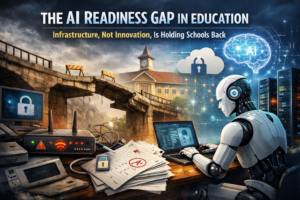 Across K–12 and higher education, artificial intelligence has moved from abstract concept to daily reality with startling speed. Students are using generative AI to study, write, and problem-solve.
Faculty are experimenting with AI-driven grading, tutoring, and curriculum design. Administrators are exploring AI for enrollment management, advising, and operational efficiency.
And yet, in many schools, the most consequential AI conversation is happening far away from classrooms and lecture halls. It is happening inside IT departments, where leaders are confronting an uncomfortable truth: enthusiasm for AI has outpaced the infrastructure required to support it.
The result is a growing AI readiness gap. Not a lack of ideas, but a lack of preparedness.
AI adoption is not a software problem
Much of the public conversation around AI in education frames adoption as a matter of selecting the right tools. Which platform is best? Which model is safest? Which features align with learning outcomes?
For IT leaders, those questions come later.
Before AI can be meaningfully deployed, schools must grapple with foundational issues that have lingered for years: network capacity, device management, identity governance, data security, and legacy systems that were never designed for always-on, cloud-based workloads.
Generative AI is resource-intensive. It increases demand on networks already strained by video learning, cloud applications, and 1:1 device programs. In districts and institutions where bandwidth planning has lagged, AI simply becomes another point of failure.
In higher education, where decentralized IT environments are common, AI tools often emerge through departments and faculty experimentation, bypassing formal review and security protocols. What looks like innovation at the surface can quickly turn into unmanaged sprawl underneath.
Shadow AI is the new shadow IT
If shadow IT was the defining governance challenge of the cloud era, shadow AI is rapidly becoming its successor.
Faculty and students are already using public AI tools with institutional data, often without clear guidance on acceptable use, data retention, or privacy implications. This is not a failure of policy alone; it is a failure of readiness.
When institutions move slowly, users move anyway.
IT teams are left trying to retroactively secure environments that were never designed to support AI at scale. Identity systems that struggle with role-based access control now must account for AI agents. Logging and monitoring tools built for traditional applications must adapt to opaque AI workflows. Data classification practices that were “good enough” suddenly matter a great deal.
The infrastructure everyone forgot still matters
One of the least discussed aspects of AI readiness is how deeply it intersects with existing, often overlooked infrastructure.
Printing is a useful example.
Despite years of digital transformation, print remains essential in education. Testing, special education accommodations, transcripts, financial aid documentation, and accessibility requirements all rely on it. AI does not eliminate these needs; in many cases, it increases them by accelerating content creation.
When AI-generated materials move from screen to paper, unmanaged print environments become a security and cost liability. Sensitive data produced faster than ever can just as easily be left on an unsecured printer. Sustainability goals are undermined when AI-driven workflows quietly increase output.
AI readiness is not just about new technology layers. It is about understanding how emerging tools interact with systems schools already depend on.
Security and privacy risks are structural, not theoretical
Education has long been a prime target for cyberattacks, and AI expands the attack surface considerably.
AI tools often require access to large datasets, raising questions about student data privacy, FERPA compliance, and institutional data governance. Many AI platforms are cloud-based and evolve rapidly, complicating vendor risk assessments and contract negotiations.
At the same time, AI is being used by attackers. Phishing attempts are more convincing. Social engineering is more personalized. Defensive strategies that rely heavily on user awareness training are increasingly insufficient.
This puts IT leaders in a difficult position. They are asked to enable innovation while simultaneously locking down environments that were not built for this level of complexity. Without investment in modern identity management, endpoint security, and continuous monitoring, AI adoption increases institutional risk rather than reducing it.
Equity gaps are widening, not closing
AI is often framed as a democratizing force in education, but infrastructure gaps tell a different story.
Schools serving lower-income communities are more likely to struggle with aging devices, inconsistent connectivity, and limited IT staffing. When AI tools assume reliable access and modern hardware, disparities widen.
Even within institutions, uneven access creates problems. Students may have AI-powered support at home but limited access on campus. Faculty may experiment freely while students navigate unclear or inconsistent policies.
True AI readiness requires viewing equity as an infrastructure challenge, not a philosophical one. Without intentional planning, AI adoption reinforces the very gaps education systems are trying to close.
What readiness actually looks like
AI readiness is not achieved through a single purchase or policy update. It is the outcome of sustained, coordinated effort across IT, academic leadership, and administration.
At a minimum, readiness includes:
-
Scalable network and cloud infrastructure designed for increased demand
-
Clear governance frameworks for AI tools, data use, and vendor relationships
-
Modern identity and access management systems
-
Integrated security practices that assume AI will be used, formally or informally
-
Visibility into legacy systems, including print and device management
-
Equity-focused planning that accounts for access beyond the classroom
Perhaps most importantly, it requires shifting the conversation. AI cannot be treated as an add-on or pilot project. It must be understood as a force multiplier that amplifies both strengths and weaknesses in existing environments.
The role of IT leadership
For education IT leaders, this moment is both challenging and clarifying.
AI has made invisible infrastructure visible again. It has exposed the cost of deferred maintenance, fragmented governance, and underinvestment in core systems. At the same time, it has created an opportunity for IT leaders to assert a more strategic role in institutional decision-making.
The schools and institutions that succeed with AI will not be those that adopt the most tools, but those that build the strongest foundations.
Innovation follows readiness. Not the other way around.
Source link
#Readiness #Gap #Education #Infrastructure #Innovation #Holding #Schools

