


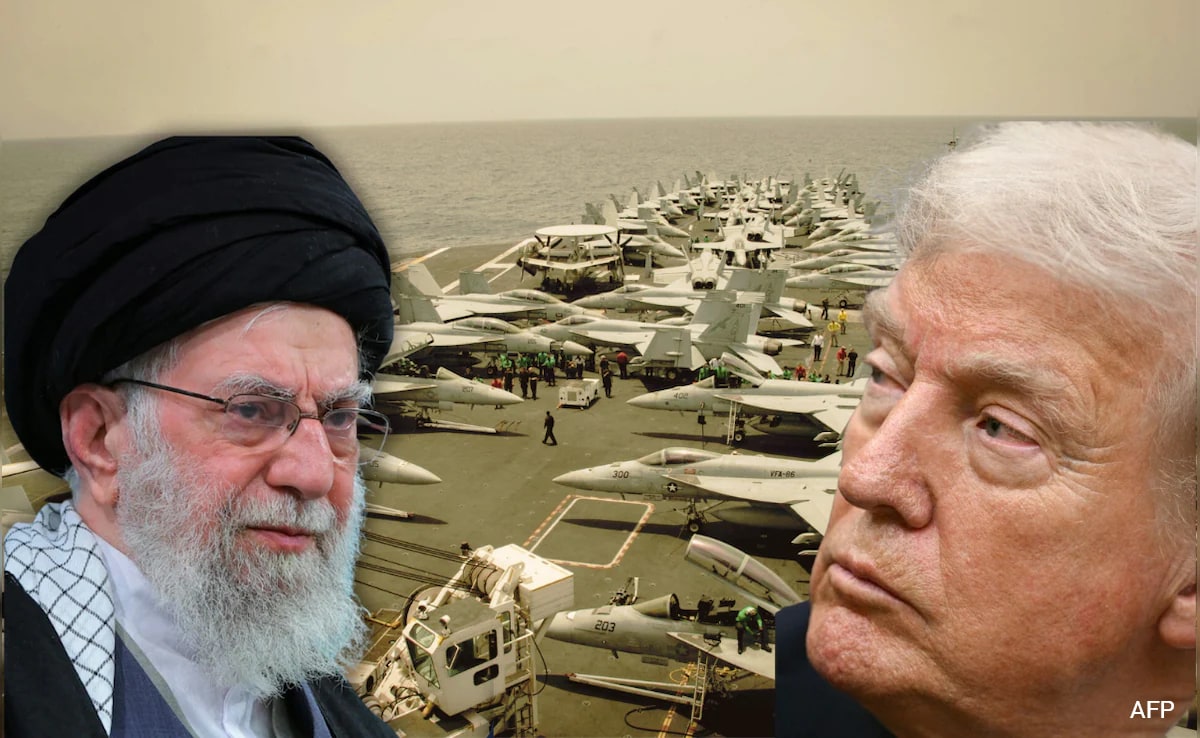
Two American carrier strike groups are now positioned within operational reach of Iran. One, the USS Abraham Lincoln, has been tracked roughly 700 kilometres from the Iranian coastline. Another has been dispatched to reinforce the American military posture across the Gulf. In Tehran, Iran’s Supreme Leader Ayatollah Ali Khamenei has responded with rhetoric that leaves little room for ambiguity. American power, he said, would not succeed in destroying the Islamic Republic.
A US warship, he warned, could itself be sunk.
Between those two signals, the projection of overwhelming military force and the language of defiance, lies a diplomatic process unfolding quietly in Geneva, mediated by Oman, where American and Iranian officials have resumed talks in an attempt to avoid escalation.
Advertisement – Scroll to continue
The deeper question is whether this moment represents a genuine prelude to conflict, or another episode in the long, cyclical confrontation that has defined US Iran relations for decades.
“This is a very serious moment right now, given that the stakes are incredibly high, we’ve already seen the US and Israel strike Iran within the past year, and Trump has been very very clear with his rhetoric that if there is no deal reached, then there will be force used,” Simon Mabon, professor of International Politics at Lancaster University, told NDTV.
Flashpoints
During the 12-day Iran-Israel war in June, the United States briefly joined Israeli strikes on Iranian nuclear facilities. That precedent means the threat of force today cannot easily be dismissed as rhetorical positioning.
Professor Mabon pointed to a central uncertainty driving the instability which is the absence of clarity about what Washington actually wants from negotiations.
“Part of the problem is right now that there is no clear set parameter as to what is included within his so-called deal. There’s a distance between some of the various parties involved over what should be covered by these talks, and that doesn’t bode well, particularly when you’ve got an increasing tensions, when you’ve got an increased military build-up in the Gulf,” he told NDTV.
“And I would argue that this is part of a strategy of coercive diplomacy, the sense that it’s trying to put pressure on Iran to say, look, we are serious, we are going to do what we say we’re going to do, and we’ve got the firepower to do it, which adds an extra layer of complexity and instability to the talks,” he added.
That approach, Professor Mabon warned, inherently raises the risk of unintended escalation.
“It also makes the situation far more precarious, given that if there is any type of miscommunication, misreading of the situation, or misunderstanding for that matter, then it can lead to a conflict, even if neither side necessarily wants it. And this is the classic security dilemma of international relations that leads to a spiral of tensions, even if neither side necessarily wants that to begin with,” he said.
Iran, for its part, has issued its own threats including potential strikes on US bases across the region. Yet, Tehran faces constraints that complicate its deterrence posture.
“So on the flip side, Iran has said that it could target US bases. And I think if it were just US bases, then I think it probably would target US bases. But a lot of these US bases are located in states with whom Iran has positive relations with. Iran struck a target, a US base in Qatar, and that really fractured a lot of relations with Qatar and Iran,” said Professor Mabon.
That experience, he argued, leaves Tehran in a dilemma.
“So I think Iran’s in a bit of a bind here, because it doesn’t want to target states with whom it now has broadly positive relations, but it needs to have that credible deterrent, or at least it thinks it does. So it’s saying this, but it’s also in a bit of a bind that it doesn’t necessarily want to do that,” he said.
The Bargaining Chip
Regional governments are acutely aware of that risk, which explains the intense diplomatic activity across Gulf capitals.
“And I think that’s one of the other reasons why we’re seeing such strong diplomatic measures being put into place by the Gulf states, Saudi, Qatar, Kuwait, Oman, for example, because they don’t want to see a broader escalation in tensions across the region,” he said.
The negotiations themselves, formally focused on Iran’s nuclear programme, are also layered with broader geopolitical concerns.
“I think there is a very serious part of it that is about nuclear negotiations. But this goes back to what I was saying earlier, in terms of what are the parameters of these talks? Who is setting the agenda? If it’s just the US, then perhaps it is just about the nuclear issue. But if the US is being swayed by Israel, then it also involves the support for, quote unquote, proxy actors such as Hezbollah and Hamas,” Professor Mabon said.
He added that Washington’s concerns extend beyond enrichment alone.
“I’m not sure to what extent the US is actually pushing that agenda, but the US is certainly concerned about ballistic missiles to an extent, and also the Iranian relations with China, and possibly Russia as well. So there are different things that are at stake here for different people. There are different agendas that are at play,” he said.
Iran’s bargaining position is also shaped by domestic realities. The country is facing economic pressure, inflation, and unrest following a deadly crackdown on protests last month.
“In terms of the leverage that Iran has, well, it’s not much, to be honest. Iran is on its knees financially. It’s facing a huge set of domestic unrest in Iran. People are angry. Inflation has skyrocketed. Some basic foodstuffs have gone up over 100% in value. We’ve seen the protests that took place in early January,” he told NDTV.
That internal pressure limits Tehran’s negotiating options.
“So the Iranian regime is in a real bind right now as to what pressure it can exert on the talks. I guess it has to retain a position of strength as much as possible in order to have some semblance of hope coming out of the talks. Otherwise, it will be steamrollered by the Trump administration’s diplomatic manoeuvring,” Professor Mabon argued.
The leadership therefore faces conflicting incentives.
“So it’s in a bit of a bind. If it compromises, then it shows weakness. So finding a way of getting a deal that doesn’t involve too much compromise is going to be absolutely essential. But then on the flip side, it needs to show willingness to compromise because otherwise it faces the potential wrath of the US military,” he added.
Surviving Under Sanctions
Sanctions relief remains a central Iranian objective, but also politically complicated.
“In terms of sanctions relief, I think sanctions relief is huge for the Islamic Republic, but it also risks potentially rewarding or at least being seen to reward a state who has recently oppressed its people and been guilty of killing tens of thousands. So I think there’s a real quandary here,” he said.
“In terms of regime survival, I think regime survival is key here, but I don’t think it’s just regime survival. I think it’s also broader than that to include systemic survival. So we’re not just talking about the survival of Ali Khamenei, for example, the Supreme Leader. We’re talking about the very survival of the Islamic Republic. It wants to survive. It wants to thrive and to continue to be able to operate. And I think that’s the scale of the stakes that are at play here, that the very future of the Islamic Republic is at stake,” he added.
The Proxy Network
Iran’s regional network, often described as proxy forces, has also shifted in recent years.
“In terms of the quote-unquote proxies, well, Hezbollah has been massively weakened and Hezbollah is also incredibly angry at Iran for not standing up and supporting it more when it was facing its war with Israel that ended in 24. So there’s a degree of anger there, although there is still a strong ideological affinity,” Professor Mabon said.
Other actors are more autonomous.
“The Houthis are increasingly an autonomous actor, but they are no fans of America or indeed Israel, for that matter. So I would imagine that there would be some limited Houthi intervention here,” he said.
Iraqi militias operate with their own political calculations.
“The Iraqi militias as well, they’ve got a complex relationship here because they’re not just Iranian proxies. They have their own agency. They have their own agendas and their own interests in Iraqi politics, and they’ve got to balance their own needs,” Professor Mabon said.
Taken together, he argued, Iran’s deterrence architecture is weaker than before.
“So I think the past couple of years has dramatically weakened this quote-unquote deterrence umbrella, if you will, that Iran was supposedly operating. And it leaves Iran increasingly isolated on the world stage, apart from China and Russia.”
Those relationships nonetheless provide important support.
“And I think that’s that’s really important diplomatically at the UN. It’s also allowing Iran to get some level of economic respite through sale of oil to China, but also some technological support from Russia as well through drones and the like.”
The Hormuz Threat
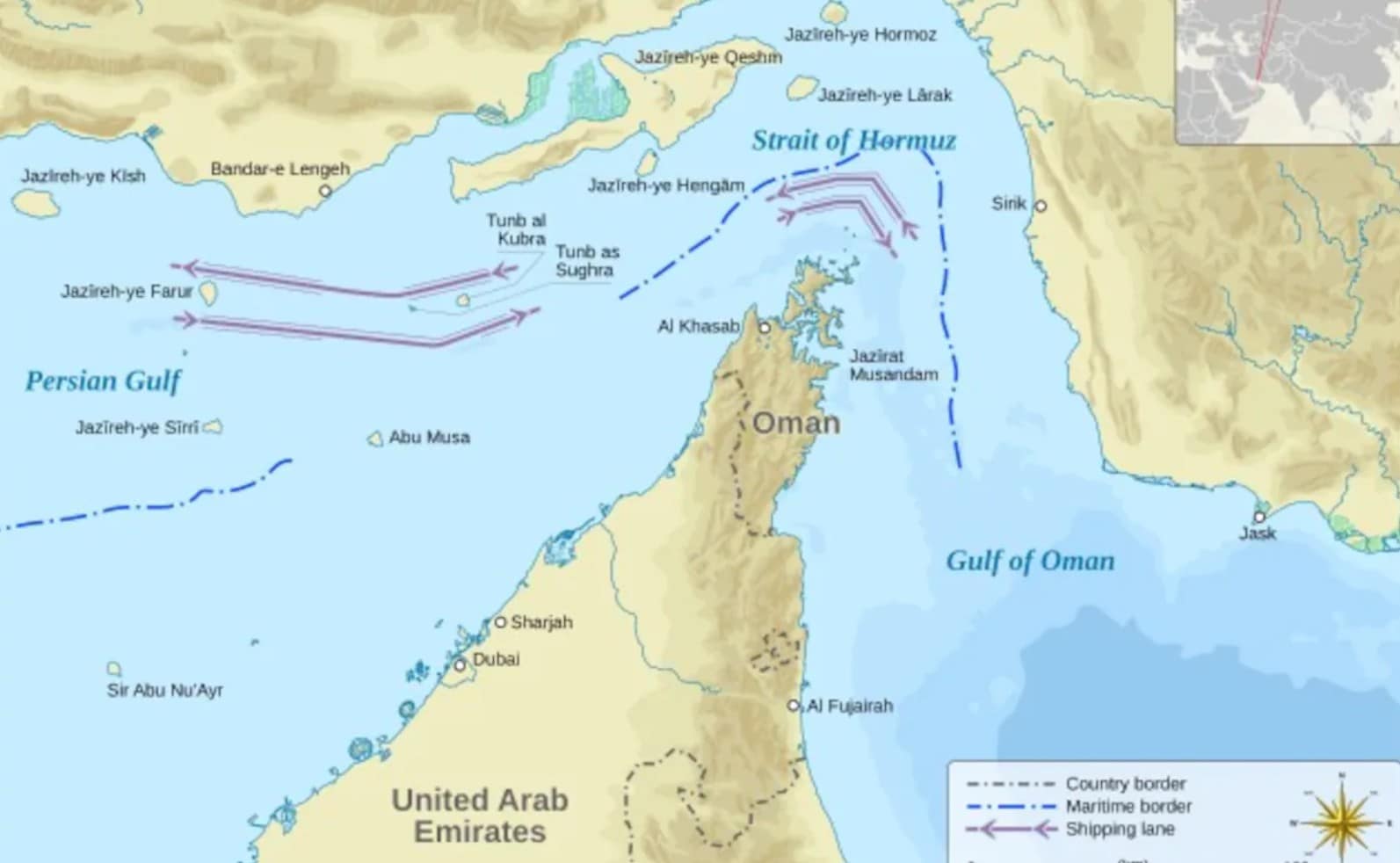
Yet the most consequential escalation risk lies not in missiles or militias, but geography, specifically the Strait of Hormuz, a strait between the Persian Gulf and the Gulf of Oman and one of world’s critical choke points.
“But I think the more important one pertains to the Strait of Hormuz. And that possible threat or that threat that has always been on the cards and has always been a big fear for policymakers around the world, that Iran would close the Strait of Hormuz. And that, I think, is one of the most likely things that could happen if tensions escalate further,” Professor Mabon said.
Iran has repeatedly signalled this capability.
“Iran has tried to demonstrate that it has the capacity to do that. That would have a dramatic impact on the price of oil, of course, which would reverberate around the world, have a huge impact on global supply chains as well, getting out of the Gulf, getting out of some of those really big ports in the UAE, for example,” he added.
External pressure might attempt to restrain Tehran, but the option remains viable.
“Yeah, I imagine there’d be some pressure from various actors for Iran not to do that. But if faced with some serious military, coercive, diplomatic, economic pressures, then there’s every possibility, I think, if Iran was on the ropes.”
Global Indicators
Predicting the trajectory of the crisis is unusually difficult, he said, partly because of the unpredictability of US decision-making.
“In terms of indicators, well, I guess part of this is difficult to answer in the sense that with Trump, it was difficult to know, because he sat down for talks with Iran, or at least his representatives did. And then whilst they were in the midst of doing that, he ordered the bombing of Iranian nuclear facilities.”
Traditional diplomatic signals therefore offer limited guidance.
“So normally, I would say if the talks are continuing, then that’s a good sign. But with Trump, it’s not entirely clear.” he said. “I think what is perhaps clear is if we’re getting positive sounds from the Omanis, who are the intermediaries, we’re getting positive sounds from other Gulf states as well, Saudi, Qatar, Kuwait, for example. Because the U.S. and Iran are trying to spin this. They’re going to be the ones spinning it in their own way.”
Public messaging from Washington may also provide clues.
“I guess if things are going positively for the Trump administration, then we’ll hear something on one of his social media networks. But it’s really difficult to tell, because this is a very high stakes game of poker, and one that involves a huge amount of subterfuge.”
That metaphor, high-stakes poker, captures the essence of the current moment.
On the ground, negotiations in Geneva are proceeding through indirect exchanges via Omani mediators. Iranian officials have signalled cautious optimism that Washington’s position has become more “realistic”, while President Donald Trump has warned of consequences if Tehran fails to reach an agreement.
Iran insists its right to enrich uranium is non-negotiable, while the United States has pushed for zero enrichment and has sought to expand negotiations to include ballistic missiles and Tehran’s support for armed groups – issues strongly advocated by Israel.
Iran’s Revolutionary Guards have launched military exercises in the Strait of Hormuz, temporarily closing sections of the waterway for safety reasons. Around a quarter of global seaborne oil and roughly a fifth of liquefied natural gas transit through that narrow passage, making it one of the world’s most strategically sensitive chokepoints.
The diplomatic effort itself follows the collapse of earlier talks during last year’s Iran-Israel war, after Israeli strikes triggered a regional conflict that briefly drew in the United States.
Source link
#Carriers #Deployed #Missiles #Ready #Close #USIran #Conflict

